
Part 3: Dr. Robert Morris
Dr. Robert Morris (2013/2014) / Clipper, Morris & Russell-Kaplan (2017) – Dallas County, Texas Pretrial Release Study

In Part 3 of our series, The Six Most Significant Bail Studies, we look at a powerful study done in Dallas County, Texas, by Dr. Robert Morris. What is so unique about Dr. Morris’ study is that it was the first study of its kind to put a cost on a failure to appear. Ultimately, what Dr. Morris was able to prove in his study is that it provides strong evidence that financially secured surety bonds are among the most effective and cost-efficient tools for ensuring court appearances.
The research examined nearly all pretrial releases in Dallas County in 2008 (approximately 22,000–29,000 cases from a larger pool of over 29,000 bookings). Using advanced propensity score matching, the authors created statistically comparable groups of defendants across four release mechanisms: commercial surety bonds (financially secured bail bonds posted through licensed bondsmen), cash bonds, attorney bonds, and pretrial services releases. This quasi-experimental approach helped isolate the effect of the release type itself, rather than differences in defendant characteristics like criminal history or charge severity.
Key Findings: Surety Bonds Outperform Other Options
The results were clear and consistent: defendants released on commercial surety bonds had significantly lower rates of failure to appear (FTA) leading to bond forfeiture compared to the other three mechanisms.
- Commercial surety bond defendants were less likely to fail to appear than those released on cash bonds, attorney bonds, or through pretrial services.
- The differences were statistically significant and held across offense categories, with particularly strong results for felonies.
- For felony defendants (among matched pairs), those not released on commercial bonds were estimated to be 39% to 56% more likely to fail to appear in court. The largest gap was between cash bonds and commercial surety bonds, followed by pretrial services and attorney bonds.
- FTA rate differences ranged from roughly 0.10 to 0.15 lower for commercial bonds versus alternatives, translating into meaningful real-world improvements in court compliance.
These findings align with the core incentive structure of the commercial surety model. When a bondsman posts a bond, they (and their insurance underwriters) assume financial liability if the defendant fails to appear. This creates a powerful, self-interested motivation for active supervision, reminders, and, when necessary, locating and returning defendants. In contrast, cash bonds and PR bonds place the full risk on the defendant or their family with less structured follow-up, while many pretrial services programs (especially the one operating in Dallas County in 2008) relied more on voluntary compliance with limited enforcement capacity at the time.
Quantifying the Taxpayer Savings
Beyond appearance rates, the study highlighted the fiscal implications. Failure to appear imposes substantial costs on the justice system through warrants, additional hearings, rearrests, and court delays. The authors referenced an estimated procedural cost of roughly $1,700 per FTA (in 2013 dollars). In Dallas County alone, thousands of FTAs in a single year translated into millions in public expenditures.
By demonstrating meaningfully lower FTA rates, the study suggests that greater use of financially secured surety bonds could generate substantial taxpayer savings by reducing these downstream inefficiencies. The commercial model effectively shifts much of the supervision and enforcement burden, and the associated financial risk, away from taxpayers and onto private actors who are incentivized to succeed.
Why This Study Matters
The Dallas County analysis stands out for several reasons:
- Rigorous Methodology: Propensity score matching allowed for fairer “apples-to-apples” comparisons than simple raw percentages, strengthening causal inferences about the release mechanism’s impact.
- Real-World Scale: It analyzed an entire jurisdiction’s releases over a full year, providing high external validity for similar large urban counties.
- Direct Relevance to Policy: At a time when many jurisdictions are moving away from financial conditions toward risk-based or unsecured release, this study provides evidence that the financial stake created by surety bonds correlates with better compliance outcomes.
- Affordability Angle: Unlike government-run supervision programs that require ongoing taxpayer funding, the surety system operates at no direct cost to the public for monitoring. Premiums are paid by defendants or their families, and the model’s success in reducing FTAs further lowers public expenditures. Additionally, by getting defendants to appear in court, the surety bail system saved Dallas County millions of dollars by avoiding wasted court time and resources for defendant non-appearances.
Critics of commercial bail often focus on other concerns (such as affordability for low-income defendants or industry practices). However, on the critical metric of ensuring court appearance, the Dallas County data indicate that financially secured surety bonds performed best among the options studied.
Bottom Line
The Morris/Clipper et al. Dallas County study provides some of the strongest available evidence that release through a financially secured surety bond is among the most effective mechanisms for promoting defendant appearance in court. By leveraging private-sector incentives and financial accountability, it achieves better compliance outcomes than cash, attorney, or (at the time) pretrial services releases, while also delivering measurable benefits to taxpayers through reduced system costs.
As policymakers continue to evaluate pretrial justice reforms, this research serves as a valuable reminder: effectiveness and affordability are not mutually exclusive. When the goal is maximizing the likelihood that defendants return to court without imposing unnecessary burdens on the public, the data from Dallas County points toward the value of the surety bond model’s built-in accountability structure.
For jurisdictions seeking evidence-based approaches that balance appearance rates, public safety considerations, and fiscal responsibility, the lessons from this large-scale, methodologically sophisticated analysis remain highly relevant.
Bail Studies Series
Intro: The Six Most Significant Surety Bail Studies Ever Conducted
The Truth, the Whole Truth and Nothing but the Truth
Over the last 30 years, there have been six key pretrial release studies that have not only supported the effectiveness of secured release over unsecured release.

PART 1: The Cohen & Reaves Study
The Most Comprehensive Pretrial Release Analysis Ever Conducted and Why Its Findings Remain Unrivaled
In November 2007, Bureau of Justice Statistics (BJS) statisticians Thomas H. Cohen, Ph.D., and Brian A. Reaves, Ph.D., published what remains the definitive national study on pretrial release: Pretrial Release of Felony Defendants in State Courts, 1990–2004.

PART 2: Helland & Tabarrok, The Fugitive
Evidence on Public Versus Private Law Enforcement from Bail Jumping (2004)
Economists Eric Helland and Alexander Tabarrok’s landmark study remains one of the most frequently cited analyses in the field because it examines why surety bonds often succeed where other pretrial release systems fall short…

PART 3: Dr. Robert Morris
Dr. Robert Morris (2013/2014) / Clipper, Morris & Russell-Kaplan (2017) – Dallas County, Texas Pretrial Release Study
Ultimately, what Dr. Morris was able to prove in his study is that it provides strong evidence that financially secured surety bonds are among the most effective and cost-efficient tools for ensuring court appearances.
PART 4: Dr. Michael Block
Part 4: Dr. Michael Block – The Effectiveness and Cost of Secured vs Unsecured Release
The fourth study in the series, the Six Most Significant Bail Studies, is Block’s 2005 study, “The Effectiveness and Cost of Secured and Unsecured Release in California’s Large Urban Counties.” This study stands out for its clear, data-driven demonstration that financially secured release through commercial surety bonds outperforms unsecured alternatives in both effectiveness and cost
Part 5: Reisig – Yolo County’s Zero Bail Study
Zero Bail Produced Significantly Higher Rates of Reoffending
The study was completed during the spring of 2020, as courts across California grappled with COVID-19 jail crowding concerns. Many counties, including Yolo County, implemented emergency “zero bail” or “cashless bail” policies. These policies automatically released large numbers of defendants accused of misdemeanors and non-violent felonies without requiring any financial posting of bail.
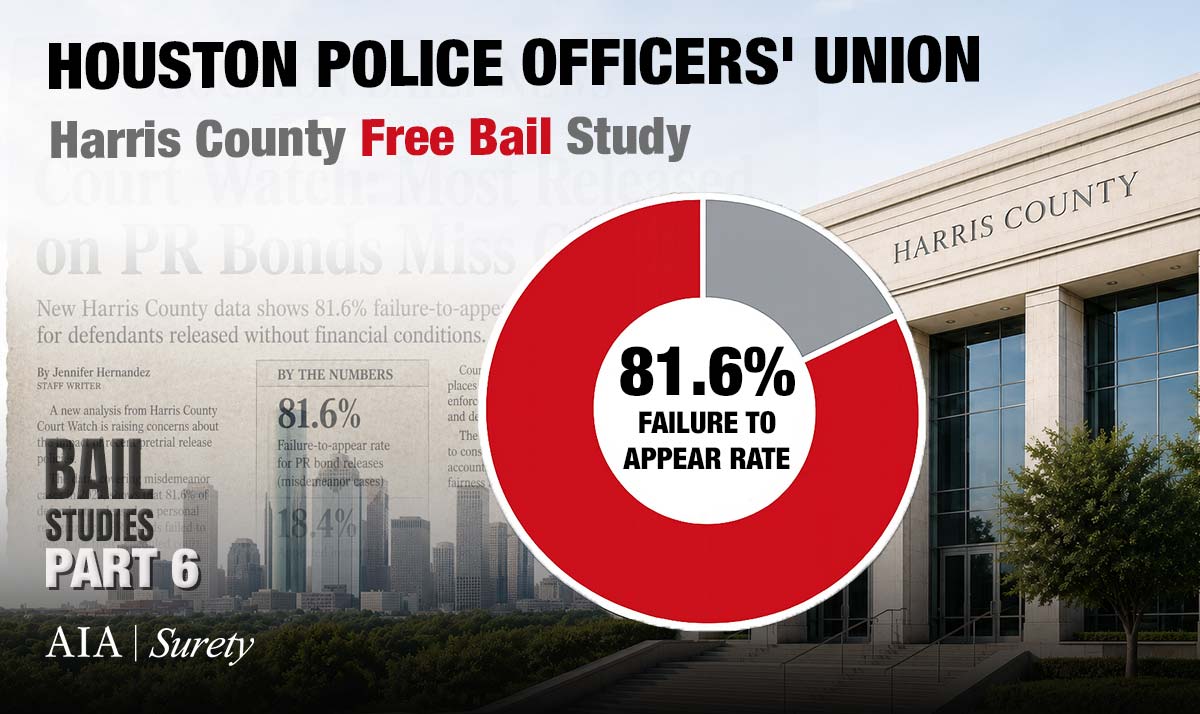
Part 6: Harris County Court Watch
The High Cost of “Free” Pretrial Release
The sixth research study we are reviewing comes out of Harris County, Texas. In 2022, the Houston Police Officers’ Union released a report on pretrial release results in Harris County following significant reforms to the county’s pretrial release process.