
Part 1: The Cohen & Reaves Study
The Most Comprehensive Pretrial Release Analysis Ever Conducted and Why Its Findings Remain Unrivaled
Pretrial Release of Felony Defendants in State Courts, 1990–2004
 In November 2007, Bureau of Justice Statistics (BJS) statisticians Thomas H. Cohen, Ph.D., and Brian A. Reaves, Ph.D., published what remains the definitive national study on pretrial release: Pretrial Release of Felony Defendants in State Courts, 1990–2004. Drawing on the State Court Processing Statistics (SCPS) program, the report analyzed felony cases filed in May of even-numbered years across a representative sample of 40 of the nation’s 75 largest counties. Each wave tracked approximately 15,000 cases for up to one year (two years for murder cases), with weighted estimates representing hundreds of thousands of defendants nationwide.
No other study before or since matches its scale, geographic breadth, or longitudinal depth. It examined real-world outcomes, release rates, time to release, and pretrial misconduct, across more than a decade and a half while controlling for offense type, criminal history, demographics, and bail amount through sophisticated multivariate logistic regression models. This was not a narrow jurisdiction-specific snapshot or a short-term pilot; it was a rigorous, multi-year examination of how the pretrial system actually operates in America’s major urban courts.
The Core Finding That Endures: Surety Bonds Deliver Superior Court Appearance Rates
Among the study’s most compelling results was the clear superiority of financially secured surety bonds for ensuring defendants appear in court. Of the 62% of felony defendants released pretrial during the study period, those released on surety bonds had an 18% failure-to-appear (FTA) rate, the lowest among major release types. In comparison, release on recognizance (ROR) showed higher FTA rates, unsecured bonds reached 30%, and emergency releases hit 45%. After applying statistical controls, predicted FTA probabilities remained lowest for surety bonds (20%) versus ROR (24%) and unsecured bonds (28%). Surety bonds also produced the lowest long-term fugitive rates (only 4% predicted to remain at large after one year).
The data further revealed a notable national trend: beginning in 1998, surety bonds surpassed ROR as the most common form of pretrial release, reflecting courts’ growing recognition of their effectiveness. By 2002–2004, surety bonds accounted for 42% of releases while ROR dropped to 23%. These shifts occurred even as overall pretrial misconduct rates remained relatively stable (31–35%), underscoring that the move toward surety bonds did not compromise public safety, it enhanced accountability.
The Obama Administration’s Attempt to Diminish the Data
During President Barack Obama’s first term, the administration and Attorney General Eric Holder addressed interpretations of pretrial release data, including the findings from the Cohen & Reaves study. In guidance issued through the Department of Justice, they stated that these results could not be used to definitively conclude that one method of pretrial release was better than another. The caution centered on the observational and descriptive nature of the State Court Processing Statistics (SCPS) data, emphasizing methodological limits when drawing strong causal claims about relative effectiveness across different release types.
Importantly, this statement did not claim that the underlying data or the study’s reported statistics were inaccurate or flawed. The advisory served as a methodological caveat rather than a refutation of the empirical findings themselves. The raw numbers, adjusted probabilities, and comparative FTA and fugitive recovery rates presented in the 2007 report stood unchallenged.
Why These Results Have Stood the Test of Time
Nearly two decades later, the Cohen & Reaves study continues to serve as the gold-standard reference in pretrial policy discussions, academic research, and legislative debates. It has been cited more than 130 times and remains the most frequently invoked source for national benchmarks on release types and outcomes. Subsequent research, whether jurisdiction-specific analyses, meta-studies, or more recent SCPS updates, consistently aligns with its central conclusion: financially secured surety bonds, backed by the private-sector incentives of bail agents and sureties, produce meaningfully better court appearance rates than non-financial alternatives.
No larger or more comprehensive national pretrial dataset has supplanted it. Later studies tend to be smaller, shorter-term, or focused on single jurisdictions, often confirming rather than contradicting the 2007 findings when comparable methodologies are used. The report’s emphasis on real-world performance metrics, raw FTA rates, adjusted probabilities, and fugitive recovery, has proven remarkably durable even as bail reform experiments have proliferated across the country.
In an era when policymakers continue to debate the most effective way to balance defendant rights with court integrity and public safety, the Cohen & Reaves study stands as enduring evidence. Its massive scope, methodological rigor, and clear documentation of surety bonds’ superior performance make it not just the most comprehensive pretrial study ever conducted, but one whose key insights have withstood the passage of time, political commentary, and the scrutiny of ongoing research. For anyone serious about evidence-based pretrial policy, this landmark BJS report remains essential reading.
Bail Studies Series

Intro: The Six Most Significant Surety Bail Studies Ever Conducted
The Truth, the Whole Truth and Nothing but the Truth
Over the last 30 years, there have been six key pretrial release studies that have not only supported the effectiveness of secured release over unsecured release.

PART 1: The Cohen & Reaves Study
The Most Comprehensive Pretrial Release Analysis Ever Conducted and Why Its Findings Remain Unrivaled
In November 2007, Bureau of Justice Statistics (BJS) statisticians Thomas H. Cohen, Ph.D., and Brian A. Reaves, Ph.D., published what remains the definitive national study on pretrial release: Pretrial Release of Felony Defendants in State Courts, 1990–2004.

PART 2: Helland & Tabarrok, The Fugitive
Evidence on Public Versus Private Law Enforcement from Bail Jumping (2004)
Economists Eric Helland and Alexander Tabarrok’s landmark study remains one of the most frequently cited analyses in the field because it examines why surety bonds often succeed where other pretrial release systems fall short…

PART 3: Dr. Robert Morris
Dr. Robert Morris (2013/2014) / Clipper, Morris & Russell-Kaplan (2017) – Dallas County, Texas Pretrial Release Study
Ultimately, what Dr. Morris was able to prove in his study is that it provides strong evidence that financially secured surety bonds are among the most effective and cost-efficient tools for ensuring court appearances.

PART 4: Dr. Michael Block
Part 4: Dr. Michael Block – The Effectiveness and Cost of Secured vs Unsecured Release
The fourth study in the series, the Six Most Significant Bail Studies, is Block’s 2005 study, “The Effectiveness and Cost of Secured and Unsecured Release in California’s Large Urban Counties.” This study stands out for its clear, data-driven demonstration that financially secured release through commercial surety bonds outperforms unsecured alternatives in both effectiveness and cost

Part 5: Reisig – Yolo County’s Zero Bail Study
Zero Bail Produced Significantly Higher Rates of Reoffending
The study was completed during the spring of 2020, as courts across California grappled with COVID-19 jail crowding concerns. Many counties, including Yolo County, implemented emergency “zero bail” or “cashless bail” policies. These policies automatically released large numbers of defendants accused of misdemeanors and non-violent felonies without requiring any financial posting of bail.
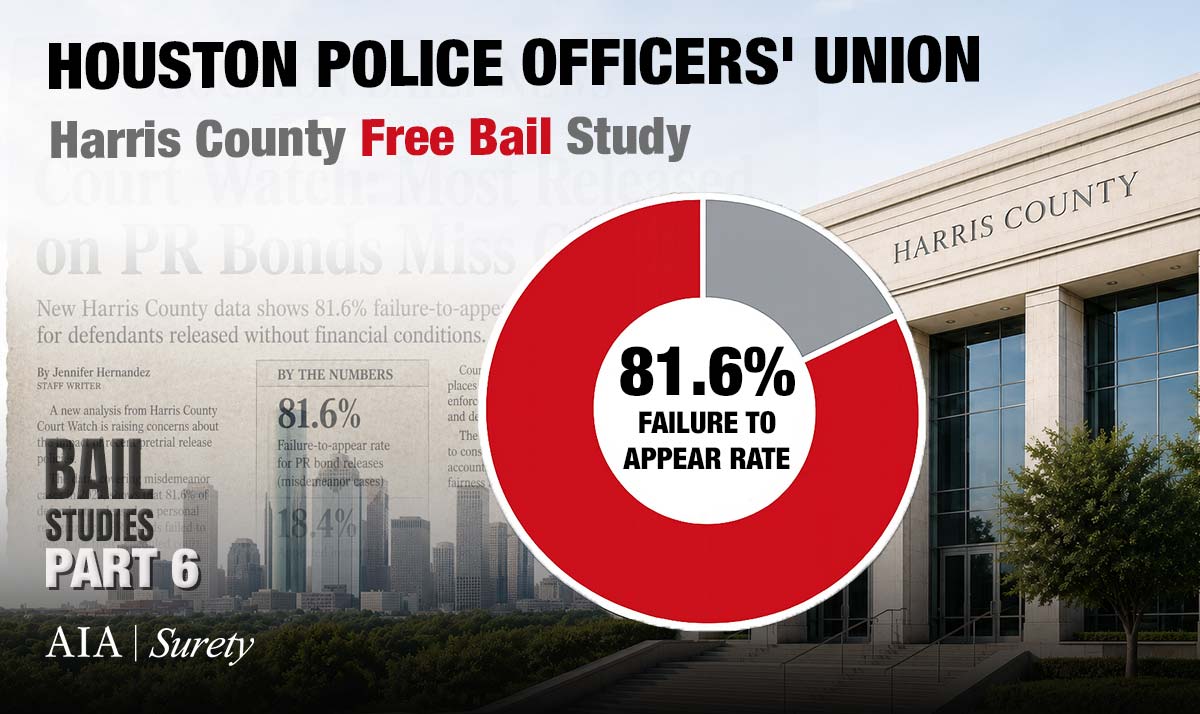
Part 6: Harris County Court Watch
The High Cost of “Free” Pretrial Release
The sixth research study we are reviewing comes out of Harris County, Texas. In 2022, the Houston Police Officers’ Union released a report on pretrial release results in Harris County following significant reforms to the county’s pretrial release process.