
Part 4: Dr. Michael Block – The Effectiveness and Cost of Secured vs Unsecured Release
Block, “The Effectiveness and Cost of Secured and Unsecured Release in California’s Large Urban Counties” (2005)
Powerful Evidence for the Effectiveness and Cost Savings of Financially Secured Surety Bonds
 The fourth study in the series, the Six Most Significant Bail Studies, is Block’s 2005 study, “The Effectiveness and Cost of Secured and Unsecured Release in California’s Large Urban Counties.” This study stands out for its clear, data-driven demonstration that financially secured release through commercial surety bonds outperforms unsecured alternatives in both effectiveness and cost. Published in March 2005 by University of Arizona economist and law professor Michael K. Block, Ph.D., the report analyzed more than a decade of Bureau of Justice Statistics (BJS) data from California’s major metropolitan areas. Block’s rigorous examination of thousands of felony cases in large urban counties provided one of the most focused, jurisdiction-specific looks at how different forms of pretrial release actually perform in real courtrooms. In an era when many jurisdictions are experimenting with “cashless” or unsecured release models, Block’s findings remain a cornerstone argument for preserving the proven private-sector surety bond system.
The study’s methodology was straightforward yet powerful. Using BJS State Court Processing Statistics, Block compared outcomes for defendants released on financially secured surety bonds versus those released on their own recognizance (ROR) or through conditional/unsecured pretrial services supervision. The data covered 1990–2000 and focused on California’s largest urban counties, the very jurisdictions where pretrial volume and policy impact are greatest. Unlike many smaller or short-term studies, Block’s analysis examined both raw failure-to-appear (FTA) rates and the broader fiscal consequences for the justice system. He also modeled the potential impact of modest policy shifts, asking what would happen if even a small percentage of unsecured releases were converted to surety bonds.
The results were striking. Defendants released on surety bonds posted a failure-to-appear rate of just 20.1%, compared to 31.8% for the combined category of ROR and conditional release. That 11.7-percentage-point difference is substantial: surety bonds reduced FTAs by more than one-third relative to unsecured options. Block went further, estimating that shifting roughly 7% of cases from unsecured release to surety bonds would prevent more than 1,000 additional FTAs annually in those counties alone. The resulting savings, from reduced court delays, fewer bench warrants, less police time spent on rearrests, and lower fugitive recovery costs, were projected at approximately $1.3 million per year in the studied jurisdictions. These are not abstract numbers; they represent real taxpayer dollars and real improvements in court efficiency and public safety.
What makes the Block (2005) study so significant is its laser focus on the core mechanism that makes surety bonds effective: financial incentives. When a commercial surety bond is posted, the bail agent and the surety company become financially liable for the full bond amount if the defendant fails to appear. This creates powerful private-sector motivation for monitoring, reminders, and, when necessary, active fugitive recovery by bondsmen and bounty hunters. In contrast, unsecured release (ROR or pretrial services) relies almost entirely on the defendant’s personal promise or limited government supervision, with far weaker consequences for non-appearance. Block’s data showed that these private incentives translate directly into higher court appearance rates and lower long-term fugitive rates, outcomes that taxpayer-funded pretrial programs have struggled to match at scale.
In the broader context of bail reform, Block’s work directly challenges the narrative that money bail is inherently unfair or ineffective. California’s large urban counties represent some of the most diverse, high-volume court systems in the nation. The fact that secured surety bonds consistently outperformed unsecured options in these demanding environments strongly suggests the model is not merely a historical artifact but a practical, scalable solution. Subsequent national studies (including Cohen & Reaves 2007 and Helland & Tabarrok 2004) have reinforced Block’s core findings, but his California-specific analysis remains uniquely valuable because it also quantifies the cost advantage of the surety system. Unsecured pretrial services require significant public funding for staffing, monitoring technology, and administration. Surety bonds deliver superior results at essentially zero cost to taxpayers.
Nearly two decades later, Block (2005) continues to be cited in legislative hearings, court opinions, and policy briefs as compelling evidence that financially secured release through surety bonds is the most effective and efficient form of pretrial release. As jurisdictions across the country experiment with cashless bail and other soft on crime experiments, this study reminds policymakers that the real issue is not money itself, but whether the release mechanism actually works. The private financial stake in surety bonds has proven time and again to be the strongest driver of court appearance and accountability.
Bail Studies Series
Intro: The Six Most Significant Surety Bail Studies Ever Conducted
The Truth, the Whole Truth and Nothing but the Truth
Over the last 30 years, there have been six key pretrial release studies that have not only supported the effectiveness of secured release over unsecured release.

PART 1: The Cohen & Reaves Study
The Most Comprehensive Pretrial Release Analysis Ever Conducted and Why Its Findings Remain Unrivaled
In November 2007, Bureau of Justice Statistics (BJS) statisticians Thomas H. Cohen, Ph.D., and Brian A. Reaves, Ph.D., published what remains the definitive national study on pretrial release: Pretrial Release of Felony Defendants in State Courts, 1990–2004.
PART 2: Helland & Tabarrok, The Fugitive
Evidence on Public Versus Private Law Enforcement from Bail Jumping (2004)
Economists Eric Helland and Alexander Tabarrok’s landmark study remains one of the most frequently cited analyses in the field because it examines why surety bonds often succeed where other pretrial release systems fall short…

PART 3: Dr. Robert Morris
Dr. Robert Morris (2013/2014) / Clipper, Morris & Russell-Kaplan (2017) – Dallas County, Texas Pretrial Release Study
Ultimately, what Dr. Morris was able to prove in his study is that it provides strong evidence that financially secured surety bonds are among the most effective and cost-efficient tools for ensuring court appearances.
PART 4: Dr. Michael Block
Part 4: Dr. Michael Block – The Effectiveness and Cost of Secured vs Unsecured Release
The fourth study in the series, the Six Most Significant Bail Studies, is Block’s 2005 study, “The Effectiveness and Cost of Secured and Unsecured Release in California’s Large Urban Counties.” This study stands out for its clear, data-driven demonstration that financially secured release through commercial surety bonds outperforms unsecured alternatives in both effectiveness and cost
Part 5: Reisig – Yolo County’s Zero Bail Study
Zero Bail Produced Significantly Higher Rates of Reoffending
The study was completed during the spring of 2020, as courts across California grappled with COVID-19 jail crowding concerns. Many counties, including Yolo County, implemented emergency “zero bail” or “cashless bail” policies. These policies automatically released large numbers of defendants accused of misdemeanors and non-violent felonies without requiring any financial posting of bail.
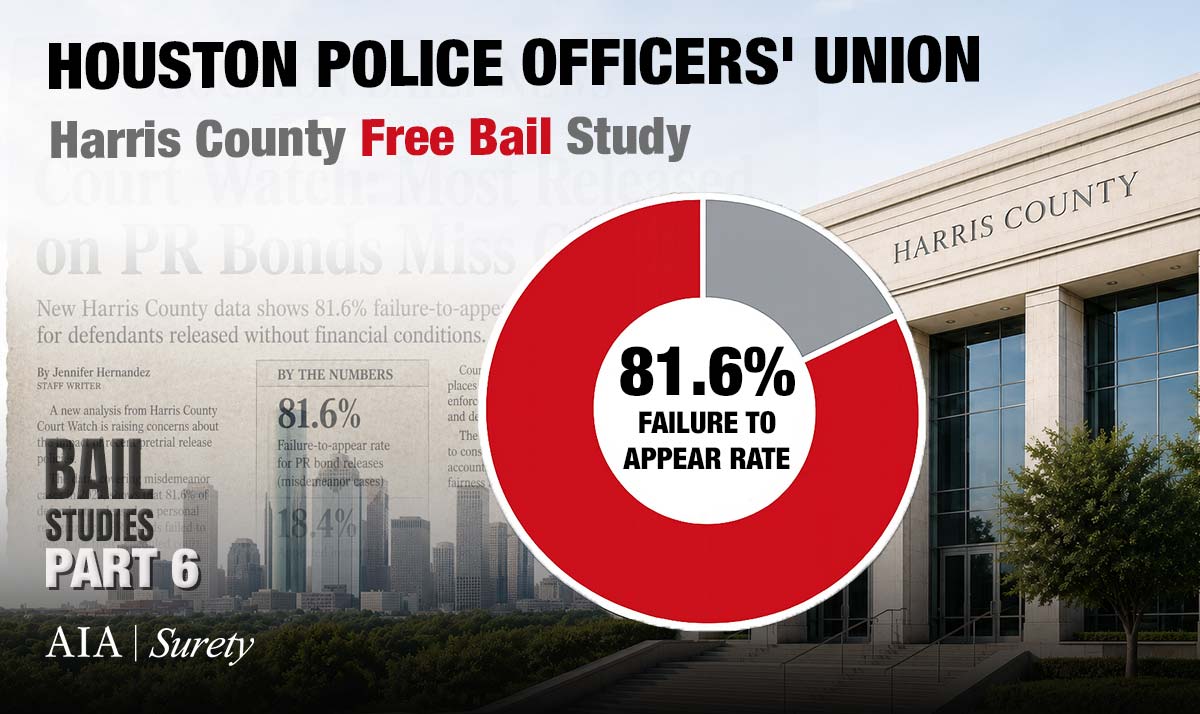
Part 6: Harris County Court Watch
The High Cost of “Free” Pretrial Release
The sixth research study we are reviewing comes out of Harris County, Texas. In 2022, the Houston Police Officers’ Union released a report on pretrial release results in Harris County following significant reforms to the county’s pretrial release process.