
Part 6: Houston Police Officers’ Union (2022), Harris County Court Watch
 Pretrial release reform has become one of the most controversial issues in criminal justice policy, with advocates arguing that unsecured release creates a fairer system while critics warn it reduces accountability and increases public safety risks. Few jurisdictions have become a larger testing ground for these reforms than Harris County, Texas.
In this sixth and final study in our series on the most significant bail studies ever conducted, we examine findings from the Houston Police Officers’ Union and the Harris County Court Watch project. The data presents one of the clearest real-world examples of what can happen when financially secured release is largely replaced by unsecured personal recognizance bonds.
Overview of the Harris County Court Watch Findings
The sixth research study we are reviewing comes out of Harris County, Texas. In 2022, the Houston Police Officers’ Union released a report on pretrial release results in Harris County following significant reforms to the county’s pretrial release process.
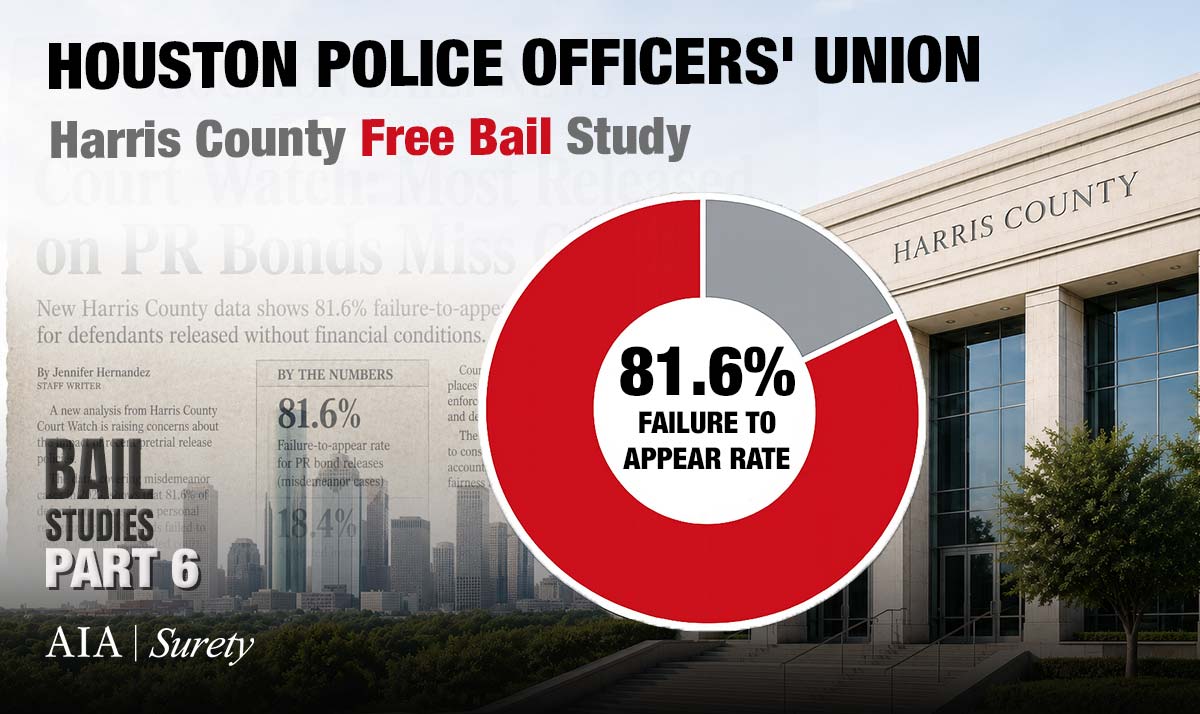
The data is presented through the Harris County Court Watch website and has produced some of the most troubling real-world data on pretrial release outcomes in the country. The organization’s tracking of Harris County misdemeanor courts shows a staggering 81.6% failure-to-appear rate, meaning only 18.4% of defendants appeared for their scheduled court dates.
These numbers, drawn from official court records, paint a clear picture: the heavy reliance on unsecured “free” releases, primarily personal recognizance bonds with little to no financial stake, is not working.
Harris County’s current system is a direct result of the O’Donnell consent decree and subsequent bail reforms, which dramatically expanded the use of unsecured personal bonds while sharply restricting the use of financially secured money bail and surety bonds for many misdemeanor cases.
The data presented on the Harris County Court Watch website demonstrates that removing the financial accountability mechanism has produced predictably poor results. When defendants have no skin in the game and no money or surety bond at risk, the incentive to appear in court collapses. The result is missed court dates, issued warrants, wasted judicial resources and delayed justice for victims.
The Contradiction Between Court Watch Data and Reform Reports
What is even more significant than the high failure-to-appear rates in Harris County is the contrast between the Court Watch findings and the reports issued by the independent monitor from Duke University Law School, who was hired to track and report the results of bail reform in Harris County.
The independent monitor reported that bail reform and the increased use of personal recognizance bonds had been successful. That conclusion stands in direct contradiction to the actual court data used to create the Harris County Court Watch website.
The monitor criticized the Houston Police Officers’ Union report, citing flaws in the research methodology and data. However, the Court Watch data was derived directly from Harris County court records, raising serious questions about how success was being measured.
Why These Numbers Matter
An 81.6% failure-to-appear rate is not a minor operational problem. It is a systemic failure. Every missed court appearance triggers a cascade of costs: law enforcement time spent serving warrants, additional jail bookings, repeated court settings and prolonged case processing.
Victims are forced to relive their trauma through multiple court dates that never happen. Defendants who repeatedly fail to appear often accumulate new charges in the meantime, creating a revolving door that undermines both public safety and the integrity of the justice system.
The data is especially significant because it comes from one of the largest and most closely watched jurisdictions in the United States. Harris County implemented sweeping changes that many reformers held up as a national model. Instead of improved efficiency and fairness, the county has experienced chronically high failure-to-appear rates that dwarf national averages and contradict the promises made by advocates of cashless and unsecured release systems.
This outcome aligns with a growing body of evidence from other jurisdictions. Studies in Yolo County, California and elsewhere have shown that removing financial conditions from pretrial release consistently correlates with higher rates of non-appearance and reoffending. The Harris County numbers reinforce a basic principle: when there is no meaningful consequence for failing to appear, many defendants simply do not appear.
The Role of Financial Accountability
Financially secured release through commercial surety bonds operates on a fundamentally different incentive structure. When a licensed bail agent posts a bond, both the defendant and the surety have a direct financial stake in ensuring the person returns to court.
This private-sector accountability has repeatedly proven more effective at producing high appearance rates than unsecured release systems that rely primarily on promises, reminders or limited government supervision.
The Harris County Court Watch findings should serve as a warning to other jurisdictions considering or already implementing similar cashless and unsecured release policies. Extremely high failure-to-appear rates are not an unavoidable cost of reform. They are evidence that certain reforms have gone too far in removing accountability from the pretrial process.
Restoring a balanced system that includes financially secured options where appropriate is not a step backward. It is a necessary correction supported by real-world results.
What This Study Means for the Future of Bail Reform
The Harris County data offers a sobering look at the consequences of pretrial policies that remove meaningful financial accountability. When more than four out of five defendants fail to appear, the issue extends far beyond administrative inefficiency. It affects victims, court resources, law enforcement and public confidence in the justice system.
As jurisdictions continue evaluating bail reform policies, Harris County serves as an important case study. The evidence suggests that accountability matters and that financially secured release mechanisms continue to play a critical role in promoting court appearance and preserving public safety.
As more communities grapple with rising court backlogs and public frustration over repeat offenders who fail to appear, the data from Harris County offers a clear lesson: “free” releases without meaningful accountability mechanisms are proving extremely expensive, both in dollars and public safety.
Key Takeaways
- Harris County Court Watch reported an 81.6% failure-to-appear rate in misdemeanor cases following major bail reforms.
- The reforms significantly expanded the use of unsecured personal recognizance bonds while limiting secured money bail and surety bonds.
- High failure-to-appear rates increase court backlogs, warrant issuance, law enforcement costs and delays for victims.
- The Harris County data aligns with other studies showing higher non-appearance rates under unsecured release systems.
- Financial accountability remains one of the strongest incentives for ensuring defendants return to court.
Sources
- Harris County Court Watch
- Harris County Court Watch Statistics
- Harris County Court Watch Analysis
- Independent Monitor Reports
Frequently Asked Questions
What is Harris County Court Watch?
Harris County Court Watch is a public-facing data project that tracks Harris County misdemeanor court outcomes using court-record data.
What failure-to-appear rate did Harris County Court Watch report?
Harris County Court Watch reported an 81.6% failure-to-appear rate in misdemeanor cases, meaning only 18.4% of defendants appeared for scheduled court dates.
Why does the Harris County data matter?
The data matters because Harris County became one of the most visible bail reform experiments in the country. Its outcomes are highly relevant to policymakers, judges, law enforcement, victims and the public.
How does unsecured release differ from surety bail?
Unsecured release often relies on a defendant’s promise to return to court without requiring a financial stake. Surety bail creates financial accountability because the defendant, indemnitor and bail agent all have an incentive to make sure the defendant appears in court.
What has been the result of the Houston Police Officers’ Union report and Harris County Court Watch website on bail reform in Texas?
The results presented in the Houston Police Officers’ Union report and on the Harris County Court Watch website have been instrumental in supporting several pieces of legislation in Texas strengthening and supporting the bail profession. This includes SB 6 in 2021, SB 9 in 2025 and SJR 5, a constitutional amendment giving judges the ability to detain violent criminals.
Bail Studies Series

Intro: The Six Most Significant Surety Bail Studies Ever Conducted
The Truth, the Whole Truth and Nothing but the Truth
Over the last 30 years, there have been six key pretrial release studies that have not only supported the effectiveness of secured release over unsecured release.

PART 1: The Cohen & Reaves Study
The Most Comprehensive Pretrial Release Analysis Ever Conducted and Why Its Findings Remain Unrivaled
In November 2007, Bureau of Justice Statistics (BJS) statisticians Thomas H. Cohen, Ph.D., and Brian A. Reaves, Ph.D., published what remains the definitive national study on pretrial release: Pretrial Release of Felony Defendants in State Courts, 1990–2004.

PART 2: Helland & Tabarrok, The Fugitive
Evidence on Public Versus Private Law Enforcement from Bail Jumping (2004)
Economists Eric Helland and Alexander Tabarrok’s landmark study remains one of the most frequently cited analyses in the field because it examines why surety bonds often succeed where other pretrial release systems fall short…

PART 3: Dr. Robert Morris
Dr. Robert Morris (2013/2014) / Clipper, Morris & Russell-Kaplan (2017) – Dallas County, Texas Pretrial Release Study
Ultimately, what Dr. Morris was able to prove in his study is that it provides strong evidence that financially secured surety bonds are among the most effective and cost-efficient tools for ensuring court appearances.
PART 4: Dr. Michael Block
Part 4: Dr. Michael Block – The Effectiveness and Cost of Secured vs Unsecured Release
The fourth study in the series, the Six Most Significant Bail Studies, is Block’s 2005 study, “The Effectiveness and Cost of Secured and Unsecured Release in California’s Large Urban Counties.” This study stands out for its clear, data-driven demonstration that financially secured release through commercial surety bonds outperforms unsecured alternatives in both effectiveness and cost

Part 5: Reisig – Yolo County’s Zero Bail Study
Zero Bail Produced Significantly Higher Rates of Reoffending
The study was completed during the spring of 2020, as courts across California grappled with COVID-19 jail crowding concerns. Many counties, including Yolo County, implemented emergency “zero bail” or “cashless bail” policies. These policies automatically released large numbers of defendants accused of misdemeanors and non-violent felonies without requiring any financial posting of bail.
Part 6: Harris County Court Watch
The High Cost of “Free” Pretrial Release
The sixth research study we are reviewing comes out of Harris County, Texas. In 2022, the Houston Police Officers’ Union released a report on pretrial release results in Harris County following significant reforms to the county’s pretrial release process.