
Accountability Matters: A Simple Text is Not Enough to Keep us Safe
How Bail Agents Outperform Automated Texts in Getting Defendants to Court
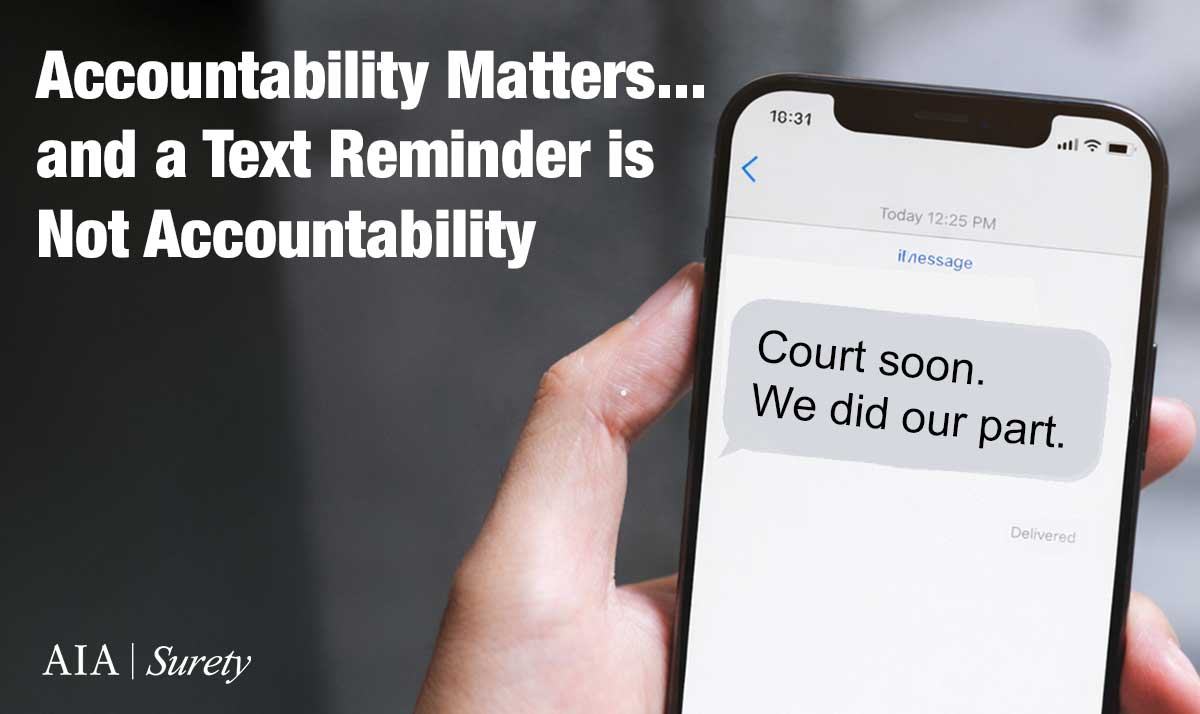
Lately, there have been a lot of articles being written on the value of a simple text reminder in the criminal justice system. Most recently, a blog post on the eCourtDate website showed that it only cost the court $9.84 to prevent a failure to appear with a text message. They compare this number to $2,850 per failure to appear when a warrant had to be issued, and the defendant had to be remanded back to jail. The problem with that calculation is that it is not that simple. A defendant’s behavior cannot be manipulated through a simple text message. It requires something much more powerful and effective. Something that a single text message does not provide, accountability.
The financially secured surety bond (also known as a commercial bail bond, where a defendant pays a non-refundable fee—typically 10-15%—to a licensed bail agent who posts the full bond amount on their behalf) has been shown in rigorous research to outperform simple notification systems like text message reminders in ensuring court appearance compliance. While text reminders represent a low-cost preventive tool that can reduce failures to appear (FTAs) by addressing forgetfulness or communication gaps, they lack the accountability mechanism inherent in surety bonds, where the bail agent actively monitors the defendant to protect the financial stake. This combination of financial incentive and personal supervision often yields higher appearance rates and lower overall system costs when FTAs do occur, compared to relying solely on passive reminders.
Evidence from Dr. Robert Morris’s Dallas County Study
In a comprehensive 2013 study by criminologist Dr. Robert G. Morris (University of Texas at Dallas), titled Pretrial Release Mechanisms in Dallas County, Texas: Differences in Failure to Appear (FTA), Recidivism/Pretrial Misconduct, and Associated Costs of FTA, researchers analyzed longitudinal data on over 22,000 defendants released pretrial from the county jail. The study compared multiple release types, including:
- Financially secured commercial bail bonds (surety bonds via bail agents)
- Cash bonds
- Attorney bonds
- Public sector pretrial unsecured (non-financial) releases
Key findings on court appearance rates showed that defendants released on commercial surety bonds had the highest compliance:
- Commercial bail bond: 77% appearance rate (lowest FTA)
- Cash bond: 71%
- Attorney bond: 66%
- Public sector pretrial unsecured bond: 63%
These differences held across misdemeanor and felony cases. The study highlighted that commercial bail’s lower FTA rates translated to reduced associated costs for the county, including avoided expenses from warrants, arrests, jail time, and case delays. Dallas County was spending over $100 million annually on pretrial detention at the time, with FTAs contributing significantly to inefficiencies and recidivism risks during the pretrial period.
Follow-up analyses, including a 2017 peer-reviewed publication in PLOS ONE (“The link between bond forfeiture and pretrial release mechanism: The case of Dallas County, Texas” by Clipper, Morris, et al.), reinforced that defendants on commercial bail bonds were significantly less likely to experience FTAs leading to bond forfeiture compared to other mechanisms. The accountability provided by bail agents—who track defendants, remind them of dates, and apprehend them if needed to avoid financial loss—creates a stronger incentive structure than unsecured or minimally supervised releases.
Comparison to Text Reminder Approaches
Recent data on court notification systems, such as automated text reminders, shows they can be effective at reducing FTAs but primarily by tackling logistical barriers for people who were already planning to show up (e.g., forgotten dates).
However, these interventions are typically applied to defendants released on minor and non-jailable offenses. And most importantly, they do not replace the need for stronger accountability in a broad set of cases, including higher-risk cases. Reminders alone lack enforcement teeth—if a defendant ignores texts, the court still incurs full FTA costs (staff time, warrants, arrests, jail). In contrast, surety bonds build in proactive supervision: bail agents often provide personalized reminders, transportation help, and direct intervention, reducing the likelihood of FTA in the first place.
Why Surety Bonds with Bail Agents Are Superior in Many Contexts
-
Higher Baseline Appearance Rates
- As Morris’s Dallas data shows, surety-bonded defendants appear more reliably (77% vs. lower rates for unsecured/public pretrial releases). Reminders might narrow gaps in unsecured releases but rarely match or exceed surety performance.
-
Built-in Accountability and Risk Management
- Bail agents have skin in the game (potential full bond forfeiture). They monitor defendants closely, which acts as a deterrent beyond passive texts. This is especially valuable for moderate- to higher-risk defendants where forgetfulness isn’t the only issue (e.g., motivation, lifestyle instability).
-
Cost Efficiency When FTAs Occur
- FTAs under surety bonds are less frequent, and when they happen, bail agents often locate and surrender defendants quickly (avoiding prolonged warrants/police involvement). Unsecured releases with only reminders can lead to higher downstream costs (e.g., $85–$140/day jail, $1,000+ per warrant execution in some jurisdictions).
-
Zero Cost to the Court/County
- As inexpensive as court reminder texts can be it is still a cost. Commercial bail operates at no cost to the court system or the county. In fact, Dr. Morris’ research points this out and calculates that the commercial bail system through its effective means of getting defendants to court saved Dallas County over $10 million.
-
Complementary, Not Mutually Exclusive
- Many jurisdictions could combine both: use surety bonds for cases warranting financial/security assurance, and layer reminders for all releases. But in head-to-head comparisons (as in Dallas), the financial stake + agent involvement outperforms minimal supervision with notifications alone.
In summary, while text reminders can be an inexpensive tool for boosting compliance for some defendants, they fall short of the proven effectiveness of financially secured surety bonds with bail agents in minimizing FTAs and associated costs. Research like Dr. Morris’s demonstrates that the personal oversight and financial incentives of surety bonds provide a more robust safeguard for court appearance, ultimately benefiting defendants, courts, and taxpayers by reducing unnecessary detention and system strain.
[…] score matching, and jurisdiction-specific datasets. They generally report lower raw or adjusted FTA rates and better fugitive recapture for surety […]