
Part 3: United States v. Salerno and Modern Bail Law
The Three Most Significant Bail Supreme Court Cases
Affirming the Constitutionality and Importance of Bail in the American Criminal Justice System
 The last supreme court case in our three-part article series on the three most significant bail supreme court cases is the 1987 case, United States v. Salerno, 481 U.S. 739. This case was truly a landmark decision that even today remains one of the most important decisions in modern bail law. While the main thrust of this case is focused on upholding the constitutionality of preventive detention under the Bail Reform Act of 1984, its deeper meaning and significance to the bail profession lies in how it reaffirmed the legitimacy of the entire bail framework. This includes the long-standing practice of releasing defendant with a financially secured surety bond. The Salerno decision provides strong constitutional support for the role of bail as a critical tool for ensuring court appearance, protecting public safety, and maintaining the integrity of the judicial process. Claims that have been made in almost every bail reform debate over the past 40 years.
Background of the Case
For purposes of clarity and education, we have provided some background on the case so that more people can fully understand its importance. Mr. Anthony Salerno was the reputed leader of the Genovese crime family. He was arrested along with co-defendant, Vincent Cafaro, and charged with racketeering under the Racketeer Influenced and Corrupt Organizations Act (RICO). Prosecutors sought to detain both defendants without bail pretrial under the Bail Reform Act of 1984. They argued that no conditions of release could reasonably assure the safety of the community. A federal district court ordered their detention. The case was appealed to the Second Circuit Court of Appeals and ultimately reversed. The court held that pretrial detention based on future dangerousness violated the Due Process Clause of the Fifth Amendment.
The case ended up reaching the Supreme Court, and in a 6-3 decision written by Chief Justice William H. Rehnquist, the Second Circuit Court of Appeals Decision was reversed, and the Bail Reform Act was upheld.
Key Holdings and Constitutional Validation
The Court held that the Bail Reform Act’s pretrial detention provisions are constitutional under both the Fifth Amendment’s Due Process Clause and the Eighth Amendment’s Excessive Bail Clause. Two principles that arose out of the opinion that are particularly important for the bail system as a whole include the following:
First, the Court ruled that pretrial detention based on a defendant’s dangerousness is a legitimate regulatory measure, not punishment. “The mere fact that a person is detained does not inexorably lead to the conclusion that the government has imposed punishment,” the Court explained. Because the detention of the defendant serves the compelling governmental interest of community safety, it falls within the government’s regulatory authority.
Second, the Court made it clear that the Excessive Bail Clause of the Eighth Amendment does not create an absolute right to bail. The Clause only requires that when bail is set, it not be excessive considering the legitimate purposes of release. “Nothing in the Clause’s text limits the Government’s interest in the setting of bail solely to the prevention of flight,” the Court wrote. When Congress determines that detention is necessary for public safety, the Eighth Amendment does not require release on bail.
These holdings reinforce a foundational truth: the Constitution permits the government to determine pretrial liberty on meaningful safeguards — including financial ones.
Salerno Supports Financially Secured Release Through Surety Bonds
Although Salerno primarily addressed preventive detention, the case still strongly validates the constitutionality and practical importance of financially secured release. The Court repeatedly recognized that release before trial is not absolute and that conditions may properly be imposed to ensure appearance and protect the public. Financial conditions, including surety bonds, are among the oldest and most established methods of providing that assurance.
By upholding a system and process that give judges the authority to release defendants under conditions or detain them when no conditions will suffice, Salerno affirms the credibility and validity of the traditional bail system and its constitutionality. The decision treats the bail process as a legitimate, carefully structured regulatory tool rather than an optional or constitutionally suspect practice.
The Supreme Court’s recognition that the government has a compelling interest in ensuring defendants appear for trial and do not endanger the community provides strong support for pretrial release mechanisms that create and support real accountability. Financially secured surety bonds do exactly that. By requiring that defendants and their indemnitors have a financial stake in the game, bail bondsmen are creating a powerful circle of influence around each and every defendant that ensures compliance with pretrial release conditions. When defendants, their families, and licensed sureties have “skin in the game,” they have powerful incentives to maintain contact, ensure court appearances, and prevent new criminal activity. And off of these are outcomes that align directly with the regulatory goals the Court endorsed in Salerno.
Affirming the Important Role of Bail
Another way Salerno reaffirms the essential role of bail in the American criminal justice system is that the Court noted that “a primary function of bail is to safeguard the courts’ role in adjudicating the guilt or innocence of defendants.” Release before trial, when appropriate, is conditioned on “adequate assurance that [the accused] will stand trial and submit to sentence if found guilty.” These statements place bail at the center of the constitutional balance between individual liberty and the government’s interest in an orderly justice system. In other words, you can’t lock everyone up and you can’t let everyone out, you must find the most fail and effective balance point, which financially secured release provides.
The court decision makes clear that liberty is the norm and detention the carefully limited exception. When release is ordered, however, the government retains the authority, and the responsibility, to impose conditions that make that release meaningful. Financially secured surety bonds are one of the most effective and time-tested ways to fulfill that responsibility without requiring the full weight of pretrial detention.
Conclusion
United States v. Salerno remains a cornerstone of modern bail law. By upholding the Bail Reform Act of 1984, the Supreme Court confirmed that the government may use the bail system to protect public safety and ensure court appearance. In doing so, the Court also reinforced the constitutional foundation for financially secured release through surety bonds. The decision stands as a powerful affirmation that bail is not merely a procedural formality, but a vital component of a justice system that balances liberty, accountability, and the safety of the community.
Sources
- United States v. Salerno, 481 U.S. 739 (1987) – Justia
- United States v. Salerno – Oyez
- Excessive Bail Prohibition: Current Doctrine – Cornell Legal Information Institute
The Three Most Significant Bail Supreme Court Cases
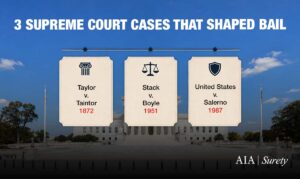
Intro: The Three Most Significant Bail Supreme Court Cases
Landmark Supreme Court Decisions That Shaped Surety Bail
This series examines three major Supreme Court cases that helped define the legal foundation of bail, surety bonds and financially secured release in America.
Part 1: Taylor v. Taintor
In 1872, the U.S. Supreme Court issued a decision that would become the legal cornerstone of the commercial surety bail system in the United States. The case, Taylor v. Taintor, 83 U.S. 366, established fundamental legal principles that continue to support the use of surety bonds more than 150 years later.

Part 2: Stack v. Boyle
In 1951, the U.S. Supreme Court issued a landmark decision in Stack v. Boyle that continues to shape bail law and policy more than seven decades later.
Part 3: United States v. Salerno
In 1987, the U.S. Supreme Court upheld the Bail Reform Act of 1984 in United States v. Salerno, one of the Court’s most important decisions affecting modern bail law.
Thank you for the article. I would ask that you denote the difference between what is actually decided vs arguments you can/could use when citing this decision. Justice Marshall in his dissent does mention the practice of Sureties; “Like the ancient practice of securing the oaths of responsible persons to stand as sureties for the accused, the modern practice of requiring a bail bond or the deposit of a sum of money subject to forfeiture serves as additional assurance of the presence of an accused.” I would ARGUE though that this dissent would make the 8th Amendment a suicide pact if it only pertains to assurance of the presence of the accused, as public safety would indeed be in doubt.
Please be assured that I love and appreciate these articles and would like to see more of them, you had me actually go read the entire decision and the dissents to this decision. Sometimes I find the dissents as informational as the decision itself. I also find it useful as WHY a case was brought before the Supreme’s. As in the case of Taylor v. Taintor, I always enjoy telling why it was brought up, it wasn’t to favor Sureties but to enforce their duties and responsibilities as a Surety.
Keep up the good work!