
Part 2: Stack v. Boyle: How the Supreme Court Affirmed Financial Accountability in Bail
In 1951, the U.S. Supreme Court issued a landmark decision in Stack v. Boyle that continues to shape bail law and policy more than seven decades later. While the case is often cited in discussions about “excessive bail,” its deeper significance lies in how it validated financially secured bail, including surety bonds, as both a constitutional tool and an effective mechanism for ensuring defendants return to court.
Background of the Case
 Stack v. Boyle arose during the height of the Cold War, when twelve individuals were charged with conspiring to violate the Smith Act by advocating the violent overthrow of the U.S. government. The district court set bail at $50,000 per defendant – an extremely high amount at the time. The defendants argued that the bail was excessive and violated the Eighth Amendment’s prohibition against excessive bail. They contended that the amount was set not to ensure their appearance, but to keep them in jail because of the political nature of the charges.
The case eventually reached the Supreme Court, which was asked to clarify what the Eighth Amendment requires when setting bail.
The Supreme Court’s Ruling
In a unanimous decision written by Chief Justice Fred Vinson, the Court held that bail is excessive when it is set higher than reasonably necessary to ensure the defendant’s appearance in court. The Court famously stated:
“Bail set at a figure higher than an amount reasonably calculated to fulfill this purpose [of assuring the presence of the defendant] is ‘excessive’ under the Eighth Amendment.”
The Court emphasized that the sole legitimate purpose of bail is to secure the defendant’s appearance at trial. It rejected the use of bail as a tool for punishment, preventive detention, or to keep politically unpopular defendants locked up. Importantly, the Court recognized that financial conditions — such as cash bail or surety bonds — are a legitimate and constitutional means of achieving this goal.
Constitutional Validation of Financially Secured Bail
Stack v. Boyle played a critical role in affirming that financially secured bail is constitutionally permissible. By tying the Eighth Amendment analysis directly to the goal of ensuring appearance, the Court implicitly endorsed the use of money as a tool to create accountability.
The decision made clear that:
- Bail does not have to be free or unsecured.
- Judges may impose financial conditions when they are reasonably related to the risk of flight.
- The amount must be individualized and based on the specific circumstances of the defendant and the case.
This ruling provided strong constitutional support for the traditional surety bond system, in which a defendant (or their indemnitors) has “skin in the game.” It rejected the notion that requiring financial security for release is inherently unfair or unconstitutional.
Affirming Effectiveness
Beyond its constitutional holding, Stack v. Boyle also supports the practical effectiveness of financially secured bail. The Court recognized that the threat of financial loss, whether through forfeiture of a surety bond or loss of cash bail, creates a powerful incentive for defendants to return to court.
This stands in contrast to purely unsecured release or broad “cashless bail” policies, where defendants face little to no financial consequence for failing to appear. The logic of Stack v. Boyle suggests that when defendants (and those who support them financially) have something to lose, they are more likely to comply with court orders. This principle aligns with decades of data showing that defendants released on commercial surety bonds tend to have higher appearance rates than those released without financial conditions.
Lasting Impact on Modern Bail Debates
Stack v. Boyle remains highly relevant today as states and localities debate bail reform. Reform advocates often argue that money should play no role in pretrial release decisions. However, Stack v. Boyle stands for the proposition that financial conditions are not only constitutional but can serve a legitimate and effective purpose.
Courts and policymakers defending traditional surety bail systems frequently cite Stack v. Boyle to argue that:
- Eliminating financial accountability entirely may undermine the court’s ability to ensure appearance.
- Judges should retain the discretion to impose reasonable financial conditions when appropriate.
- The focus should remain on individualized risk assessments rather than blanket prohibitions on money bail.
The case continues to serve as a constitutional anchor for those who believe that a balanced system, one that includes both release options and meaningful accountability, best serves the interests of justice and public safety.
Conclusion
Stack v. Boyle did more than prohibit excessive bail. It affirmed that financially secured bail is a constitutional and effective tool for ensuring defendants return to court. By grounding the Eighth Amendment in the practical purpose of securing appearance, the Supreme Court gave lasting legitimacy to the surety bond system that remains in use across much of the country today.
In an era of ongoing bail reform debates, Stack v. Boyle reminds us that the question is not simply whether money should ever be involved in release decisions, but whether financial accountability, when properly calibrated, can help maintain the integrity of the judicial process while protecting both defendants’ rights and community safety.
Key Takeaways
- Bail must be reasonably calculated to ensure appearance. In Stack v. Boyle, the Supreme Court held that bail set higher than necessary to fulfill this purpose is excessive under the Eighth Amendment.
- Financially secured bail is constitutionally permissible. The decision affirmed that financial conditions may be used as a legitimate means of ensuring defendants return to court.
- Bail decisions should be individualized. Courts must consider the specific circumstances of the defendant and the case rather than relying on blanket or arbitrary conditions.
- Financial accountability creates an incentive to appear. The principles established in Stack v. Boyle continue to support the role of secured bail in encouraging compliance with court obligations.
- The case remains relevant to modern bail reform debates. More than seven decades later, Stack v. Boyle continues to shape discussions about excessive bail, financial conditions and judicial discretion.
Frequently Asked Questions About Stack v. Boyle
What was Stack v. Boyle?
Stack v. Boyle was a 1951 U.S. Supreme Court case involving twelve defendants who challenged $50,000 bail amounts as excessive under the Eighth Amendment. The case became a landmark decision defining when bail may be considered constitutionally excessive.
What did the Supreme Court rule in Stack v. Boyle?
The Supreme Court held that bail is excessive when it is set higher than an amount reasonably calculated to ensure a defendant’s appearance in court. The decision emphasized that bail must be based on the circumstances of the individual defendant and the case.
Did Stack v. Boyle prohibit cash bail or financially secured bail?
No. Stack v. Boyle did not prohibit financial conditions of release. The decision recognized that financial conditions may be used to ensure a defendant’s appearance, provided the amount is reasonably related to that purpose and is not excessive.
Why is Stack v. Boyle still important today?
Stack v. Boyle remains an important part of modern bail law because it established the constitutional standard for excessive bail. The case continues to influence debates over financial conditions, judicial discretion, individualized bail decisions and cashless release policies.
Sources
- Stack v. Boyle, 342 U.S. 1 (1951). Official U.S. Supreme Court opinion. Available through:
- Stack v. Boyle, 342 U.S. 1, 4–5 (1951) (holding that bail is excessive under the Eighth Amendment when set higher than an amount reasonably calculated to assure the defendant’s presence at trial).
- Stack v. Boyle, 342 U.S. 1, 5 (1951) (“Bail set at a figure higher than an amount reasonably calculated to fulfill this purpose is ‘excessive’ under the Eighth Amendment.”).
Online References
- Stack v. Boyle, 342 U.S. 1 (1951), available at Justia (last visited July 14, 2026).
- Stack v. Boyle, Legal Information Institute, Cornell Law School, available at Cornell Law School (last visited July 14, 2026).
- Stack v. Boyle, Oyez, available at Oyez (last visited July 14, 2026).
Related Bail Research & Resources
Looking for additional research, statistics and educational resources? Explore the links below for more information on pretrial release, bail reform and the commercial surety bail system.
- The Six Most Significant Surety Bail Studies Ever Conducted: Research highlighting the effectiveness of commercial surety bail compared to other forms of pretrial release.
- Bail Research Library: Research studies, reports and data related to pretrial release and bail.
- Bail Resources: Educational resources covering bail, court procedures and the criminal justice system.
- Bail Bond FAQs: Answers to common questions about bail bonds and the pretrial release process.
- Bail Reform Articles: Commentary, analysis and updates related to bail reform initiatives and legislation.
The Three Most Significant Bail Supreme Court Cases
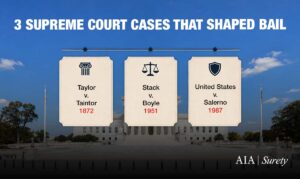
Intro: The Three Most Significant Bail Supreme Court Cases
Landmark Supreme Court Decisions That Shaped Surety Bail
This series examines three major Supreme Court cases that helped define the legal foundation of bail, surety bonds and financially secured release in America.
Part 1: Taylor v. Taintor
In 1872, the U.S. Supreme Court issued a decision that would become the legal cornerstone of the commercial surety bail system in the United States. The case, Taylor v. Taintor, 83 U.S. 366, established fundamental legal principles that continue to support the use of surety bonds more than 150 years later.
Part 2: Stack v. Boyle
In 1951, the U.S. Supreme Court issued a landmark decision in Stack v. Boyle that continues to shape bail law and policy more than seven decades later.
Part 3: United States v. Salerno
In 1987, the U.S. Supreme Court upheld the Bail Reform Act of 1984 in United States v. Salerno, one of the Court’s most important decisions affecting modern bail law.
Great article. It is hard to understand how anyone can question the legitimacy and effectiveness of financially secured release.