
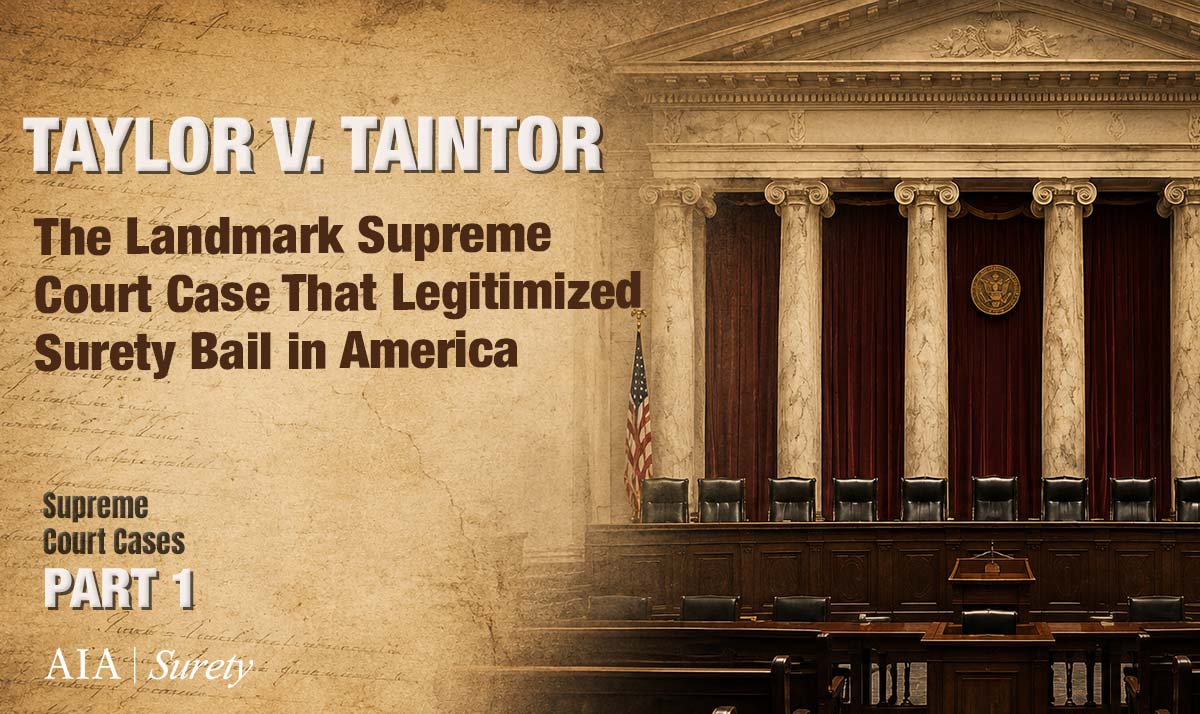
Part 1: Taylor v. Taintor: The Landmark Supreme Court Case That Legitimized Surety Bail in America
The bail profession has a long history. From biblical times to the modern era, bail has played an essential role in balancing individual liberty with the need to ensure defendants return to court. Over the years, the concept of bail has been debated and challenged at every level of the judicial system, including the United States Supreme Court. Several landmark decisions have helped shape today’s pretrial system, reaffirming important legal principles surrounding financially secured release.
This article is the first installment in our three-part series, The Three Most Significant Bail Supreme Court Cases. We begin in 1872 with one of the most influential decisions in the history of commercial surety bail: Taylor v. Taintor.
In 1872, the U.S. Supreme Court issued a decision that would become the legal cornerstone of the commercial surety bail system in the United States. The case, Taylor v. Taintor, 83 U.S. 366, established fundamental legal principles that continue to support the use of surety bonds more than 150 years later. While many court decisions have shaped bail policy over time, few have had as lasting and direct an impact on the structure and legitimacy of the surety bail industry.
Background of the Case
The case arose when sureties posted an $8,000 bail bond for a defendant named McGuire in Connecticut after he was charged with grand larceny. After being released, McGuire fled to New York, where he was later arrested on unrelated charges and extradited to Maine. Because he failed to appear in Connecticut court, the bond was forfeited.
The sureties argued they should be relieved of liability because McGuire’s failure to appear resulted from his extradition to another state, an event they claimed was beyond their control.
The Supreme Court rejected this argument. In a decision written by Justice Noah Swayne, the Court made several critical rulings that defined the legal relationship between a defendant and their surety.
The Supreme Court’s Landmark Ruling
The Court held that when a defendant is released on a surety bond, they are effectively delivered into the custody of the surety. The surety assumes responsibility for ensuring the defendant’s appearance and, in return, gains significant authority over the defendant.
The Court famously stated:
“When bail is given, the principal is regarded as delivered to the custody of his sureties. Their dominion is a continuance of the original imprisonment. Whenever they choose to do so, they may seize him and deliver him up in their discharge…”
This language established that sureties have broad authority to apprehend and surrender their principals. The Court compared these powers to those of a sheriff re-arresting an escaped prisoner. The decision made it clear that a surety bond is not merely a financial guarantee, but also represents a contractual transfer of custody.
How Taylor v. Taintor Validated Surety Bail
The ruling was groundbreaking because it provided clear legal authority for the commercial surety system. Prior to this decision, the role of paid sureties was less clearly defined. Taylor v. Taintor recognized that sureties possess important legal rights and responsibilities, including:
- Legal standing to actively monitor defendants they have bonded.
- Authority to apprehend defendants who violate the terms of their release, including pursuing them across state lines.
- Recognition that the surety system serves a public purpose by helping ensure defendants return to court.
By affirming these powers, the Supreme Court recognized the private accountability model that defines commercial surety bail. Rather than relying solely on government supervision, the system places responsibility on the surety, along with the defendant’s indemnitors, to help ensure court appearance.
Lasting Impact on the U.S. Bail System
More than 150 years later, Taylor v. Taintor remains one of the most frequently cited cases in bail-related litigation and policy discussions. Courts across the country continue to reference it when addressing:
- The rights and responsibilities of bail bondsmen.
- The contractual nature of surety bonds.
- The authority of recovery agents to apprehend fugitives.
- Challenges to the surety bail system during bail reform debates.
The case also reinforced the principle that surety bonds create a strong financial incentive for both defendants and third-party indemnitors, often family members or friends, to ensure court appearance. This incentive structure remains one of the primary distinctions between commercial surety bail and unsecured or government-supervised release systems.
Why the Case Still Matters
As bail reform continues to be debated across the country, Taylor v. Taintor remains an important legal foundation for financially secured release. The decision recognized the role of private sureties in promoting accountability and ensuring defendants return to court.
While modern courts have placed certain limitations on surety powers, particularly regarding due process and the use of force, the core principles established in Taylor v. Taintor remain deeply embedded in American bail law. The case continues to influence legal discussions surrounding the responsibilities of sureties and the role commercial bail plays within the criminal justice system.
Conclusion
Few Supreme Court decisions have had a greater impact on the commercial bail industry than Taylor v. Taintor. By formally recognizing the custody relationship between sureties and defendants, the Court established legal principles that continue to shape the modern bail system more than a century and a half later.
Although bail laws have evolved, Taylor v. Taintor remains one of the foundational cases supporting the legal framework of commercial surety bail. Understanding this landmark decision provides important context for today’s ongoing discussions about bail reform, accountability and public safety.
Stay tuned for Part 2 of our series, The Three Most Significant Bail Supreme Court Cases, where we’ll examine another landmark Supreme Court decision that continues to influence the American bail system today.
Key Takeaways
- Taylor v. Taintor is one of the most influential Supreme Court decisions affecting commercial surety bail.
- The Court recognized that defendants released on surety bonds are considered to be in the custody of their sureties.
- The decision affirmed the legal authority of sureties to apprehend defendants who fail to meet their obligations.
- The ruling established important legal principles that continue to influence bail law today.
- More than 150 years later, the case remains a cornerstone of discussions surrounding surety bail and bail reform.
Sources
- Justia: Taylor v. Taintor, 83 U.S. 366 (1872)
- Wikipedia: Taylor vs Taintor
- Cornell Law, Legal Information Institute: Taylor v. Taintor
Frequently Asked Questions
What is Taylor v. Taintor?
Taylor v. Taintor is an 1872 United States Supreme Court case that established key legal principles governing commercial surety bail, including the custody relationship between a defendant and their surety.
Why is Taylor v. Taintor important?
The decision provided legal recognition for the authority and responsibilities of sureties, helping establish the legal framework that still supports commercial bail bonding today.
Does Taylor v. Taintor still apply today?
Yes. Although later court decisions and state laws have refined certain aspects of surety authority, Taylor v. Taintor continues to be widely cited in bail-related legal discussions and court decisions.
What authority did the Court recognize for sureties?
The Court recognized that sureties have the authority to monitor, apprehend and surrender defendants who fail to comply with the conditions of their release, subject to modern legal limitations.
Why is Taylor v. Taintor frequently discussed during bail reform debates?
Because it established many of the legal principles underlying commercial surety bail, the case is often referenced when evaluating the constitutional and legal foundations of financially secured pretrial release.
Related Bail Research & Resources
Looking for additional research, statistics and educational resources? Explore the links below for more information on pretrial release, bail reform and the commercial surety bail system.
- The Six Most Significant Surety Bail Studies Ever Conducted: Research highlighting the effectiveness of commercial surety bail compared to other forms of pretrial release.
- Bail Research Library: Research studies, reports and data related to pretrial release and bail.
- Bail Resources: Educational resources covering bail, court procedures and the criminal justice system.
- Bail Bond FAQs: Answers to common questions about bail bonds and the pretrial release process.
- Bail Reform Articles: Commentary, analysis and updates related to bail reform initiatives and legislation.
The Three Most Significant Bail Supreme Court Cases
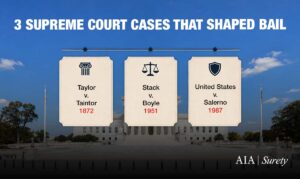
Intro: The Three Most Significant Bail Supreme Court Cases
Landmark Supreme Court Decisions That Shaped Surety Bail
This series examines three major Supreme Court cases that helped define the legal foundation of bail, surety bonds and financially secured release in America.
Part 1: Taylor v. Taintor
In 1872, the U.S. Supreme Court issued a decision that would become the legal cornerstone of the commercial surety bail system in the United States. The case, Taylor v. Taintor, 83 U.S. 366, established fundamental legal principles that continue to support the use of surety bonds more than 150 years later.
Part 2: Stack v. Boyle
In 1951, the U.S. Supreme Court issued a landmark decision in Stack v. Boyle that continues to shape bail law and policy more than seven decades later.
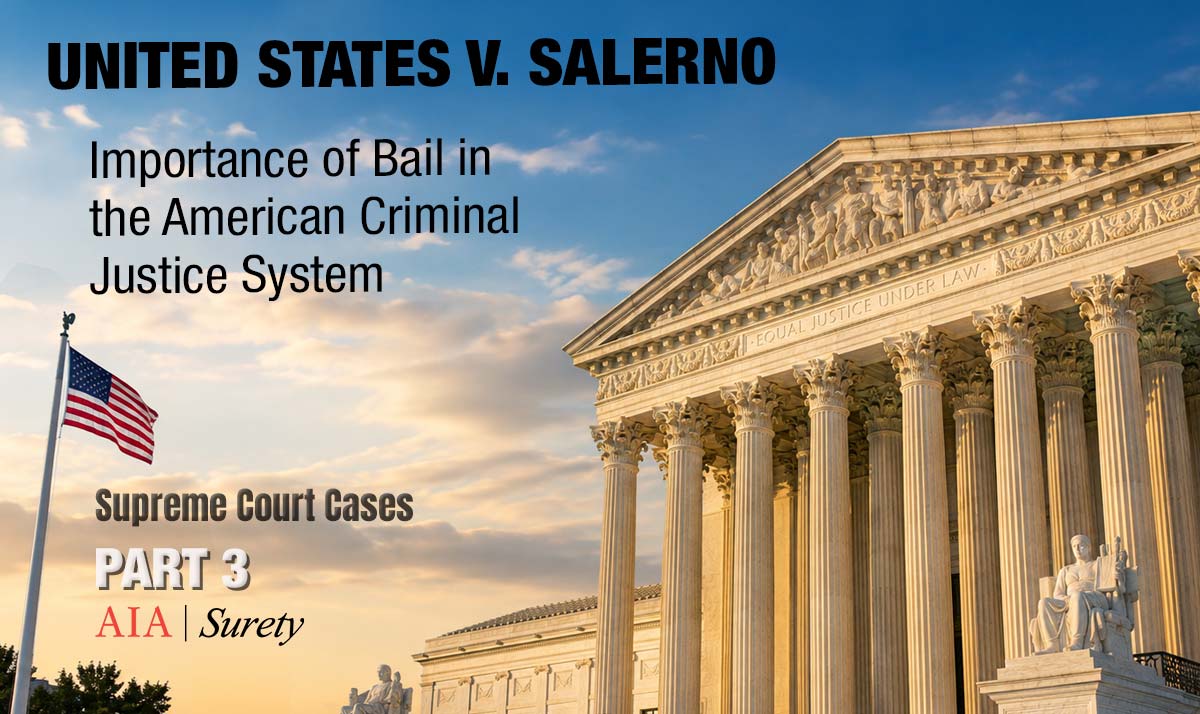
Part 3: United States v. Salerno
In 1987, the U.S. Supreme Court upheld the Bail Reform Act of 1984 in United States v. Salerno, one of the Court’s most important decisions affecting modern bail law.
Tennessee has passed legislation denying the bondsman the ability to surrender a principal for violation of the bail contract. TCA 40-11-132, section (1)) deleted by 2025 Amendment
“The defendant has violated the contractual provisions between the defendant and the bondsman ”
If it’s at all possible AIA needs to assist Tennessee bail agents in getting section 1 reinstated. I believe this deletion unlawfully impedes the bondsman’s ability to enforce his/her contract, since bail is statutorily a contractual agreement under Tennessee criminal statutes.