
Part 2: Helland & Tabarrok, The Fugitive
Evidence on Public Versus Private Law Enforcement from Bail Jumping (2004)
In the ongoing debate over bail reform and pretrial release, one question stands out: What actually works best at getting defendants back to court?
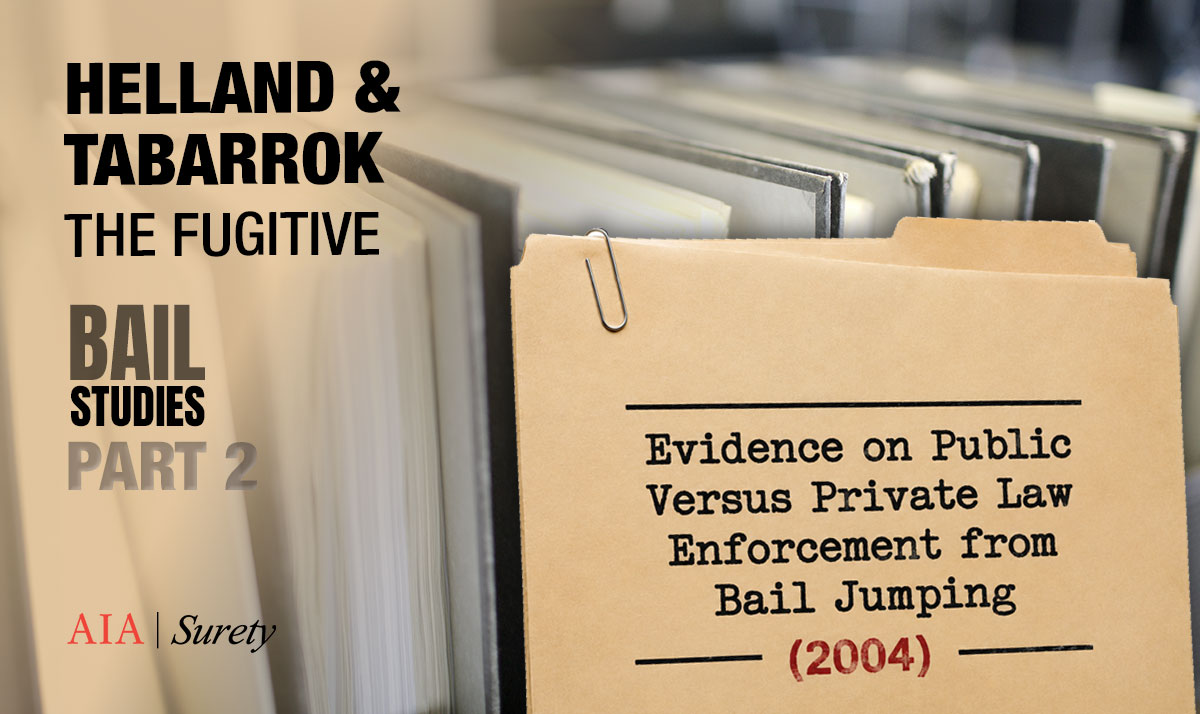
The second bail study in our six-part article series on the most significant bail studies ever conducted helps answer this question. A highly regarded peer-reviewed study published more than two decades ago provides some of the clearest economic evidence yet that financially secured release through a commercial surety bond outperforms unsecured options like release on recognizance (ROR). Titled “The Fugitive: Evidence on Public Versus Private Law Enforcement from Bail Jumping,” the 2004 paper by economists Eric Helland (Claremont-McKenna College) and Alexander Tabarrok (George Mason University) appeared in the prestigious Journal of Law & Economics. It remains one of the most frequently cited analyses in the field precisely because it moves beyond raw statistics to examine why surety bonds succeed where other systems often fall short.
Using nationally representative data from the Bureau of Justice Statistics on felony defendants, Helland and Tabarrok compared outcomes for defendants released on surety bonds versus those released on their own recognizance or through government-backed bail. To ensure apples-to-apples comparisons, they employed advanced propensity score matching techniques, a rigorous statistical method that controls for defendant characteristics such as age, criminal history, charge severity and other risk factors that could otherwise skew results. This approach allowed the researchers to isolate the effect of the type of release rather than differences in who gets which type of bond.
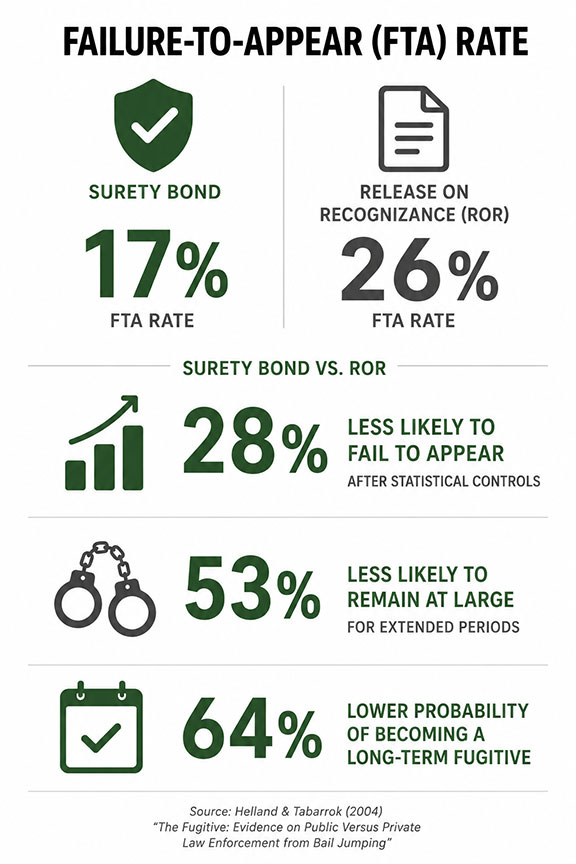 The results were striking. In raw data, defendants released on surety bonds had a failure-to-appear (FTA) rate of just 17%, compared to 26% for those released on recognizance. After applying statistical controls, defendants on surety bonds were still 28% less likely to fail to appear than otherwise identical defendants released without financial stakes. Even more telling, when defendants did jump bail, those on surety bonds were 53% less likely to remain at large for extended periods. Overall, the probability of becoming a long-term fugitive was 64% lower under surety release. These differences were not small or marginal — they represented meaningful improvements in court appearance rates and public safety.
What makes the study so significant is its laser focus on the incentive structure behind the numbers. Public law enforcement (police and courts) has the primary responsibility for pursuing defendants released on ROR or unsecured bonds. But when a defendant is released on a commercial surety bond, private actors — bail bondsmen and professional bounty hunters — have skin in the game. The bondsman is financially liable for the full bond amount if the defendant fails to appear, creating powerful incentives to monitor, remind, and, if necessary, track down the defendant. Helland and Tabarrok’s analysis demonstrates that this private enforcement system is dramatically more effective than relying solely on public resources. It is a classic illustration of how market-based incentives can outperform government monopoly in a specific law-enforcement function.
In an era when many jurisdictions are experimenting with “no-cash-bail” or expanded unsecured release programs, Helland & Tabarrok (2004) stands as a foundational piece of evidence that financially secured surety bonds are not merely a historical artifact, they are a proven, incentive-driven mechanism for ensuring court appearances and reducing fugitive rates. The study’s rigorous methodology, national scope and publication in a top-tier peer-reviewed economics journal give it enduring credibility that few other pretrial studies can match. For policymakers, judges and criminal justice professionals seeking real-world results rather than ideological slogans, this 2004 analysis remains required reading: private financial incentives work and they work measurably better at keeping defendants accountable.
Stay tuned for the next article in the six most significant bail studies series, Part 3 – Dr. Robert Morris (2013/2014) / Clipper, Morris & Russell-Kaplan (2017) – Dallas County, Texas Pretrial Release Study. Additionally, see below for previous articles in the series.
Bail Studies Series
Intro: The Six Most Significant Surety Bail Studies Ever Conducted
The Truth, the Whole Truth and Nothing but the Truth
Over the last 30 years, there have been six key pretrial release studies that have not only supported the effectiveness of secured release over unsecured release.

PART 1: The Cohen & Reaves Study
The Most Comprehensive Pretrial Release Analysis Ever Conducted and Why Its Findings Remain Unrivaled
In November 2007, Bureau of Justice Statistics (BJS) statisticians Thomas H. Cohen, Ph.D., and Brian A. Reaves, Ph.D., published what remains the definitive national study on pretrial release: Pretrial Release of Felony Defendants in State Courts, 1990–2004.
PART 2: Helland & Tabarrok, The Fugitive
Evidence on Public Versus Private Law Enforcement from Bail Jumping (2004)
Economists Eric Helland and Alexander Tabarrok’s landmark study remains one of the most frequently cited analyses in the field because it examines why surety bonds often succeed where other pretrial release systems fall short…

PART 3: Dr. Robert Morris
Dr. Robert Morris (2013/2014) / Clipper, Morris & Russell-Kaplan (2017) – Dallas County, Texas Pretrial Release Study
Ultimately, what Dr. Morris was able to prove in his study is that it provides strong evidence that financially secured surety bonds are among the most effective and cost-efficient tools for ensuring court appearances.
PART 4: Dr. Michael Block
Part 4: Dr. Michael Block – The Effectiveness and Cost of Secured vs Unsecured Release
The fourth study in the series, the Six Most Significant Bail Studies, is Block’s 2005 study, “The Effectiveness and Cost of Secured and Unsecured Release in California’s Large Urban Counties.” This study stands out for its clear, data-driven demonstration that financially secured release through commercial surety bonds outperforms unsecured alternatives in both effectiveness and cost
Part 5: Reisig – Yolo County’s Zero Bail Study
Zero Bail Produced Significantly Higher Rates of Reoffending
The study was completed during the spring of 2020, as courts across California grappled with COVID-19 jail crowding concerns. Many counties, including Yolo County, implemented emergency “zero bail” or “cashless bail” policies. These policies automatically released large numbers of defendants accused of misdemeanors and non-violent felonies without requiring any financial posting of bail.
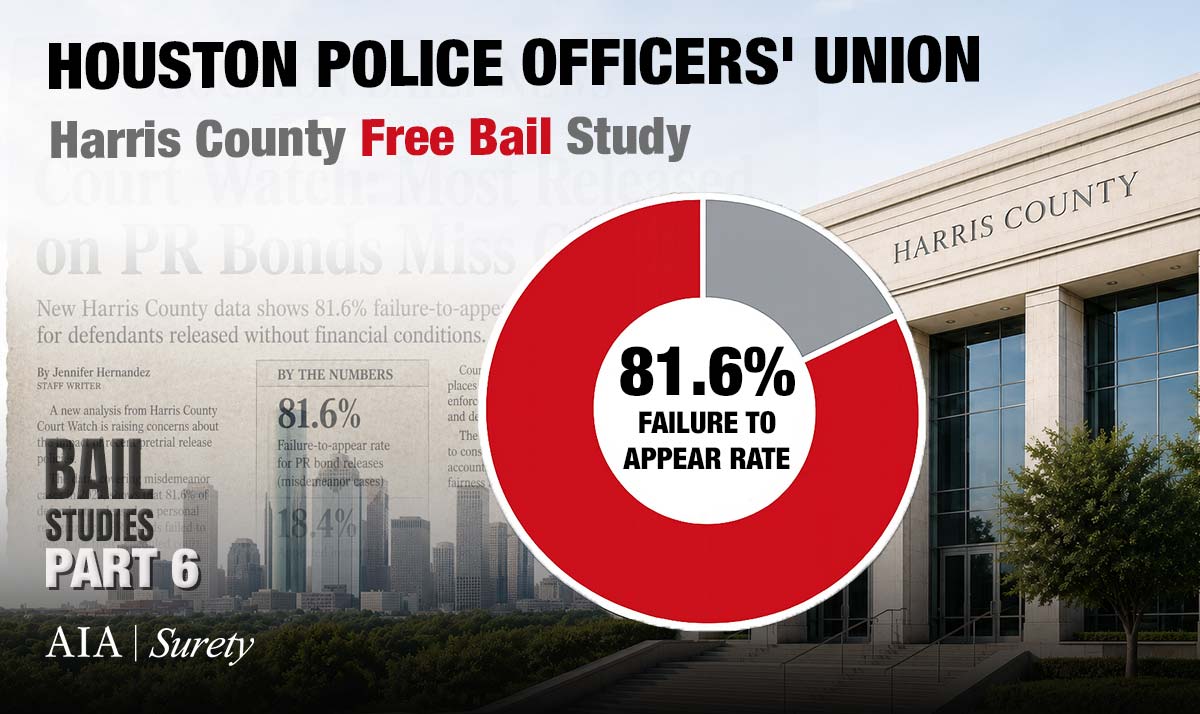
Part 6: Harris County Court Watch
The High Cost of “Free” Pretrial Release
The sixth research study we are reviewing comes out of Harris County, Texas. In 2022, the Houston Police Officers’ Union released a report on pretrial release results in Harris County following significant reforms to the county’s pretrial release process.
Thank you for sharing. More people need to see these valuable studies. No matter how long ago they were conducted, the data is the same today.
[…] PART 2: Helland & Tabarrok, The Fugitive […]