
The Dangerous Myth of “Evidence-Based” Bail Reform: How Three Prominent Studies Collapse Under Real-World Scrutiny
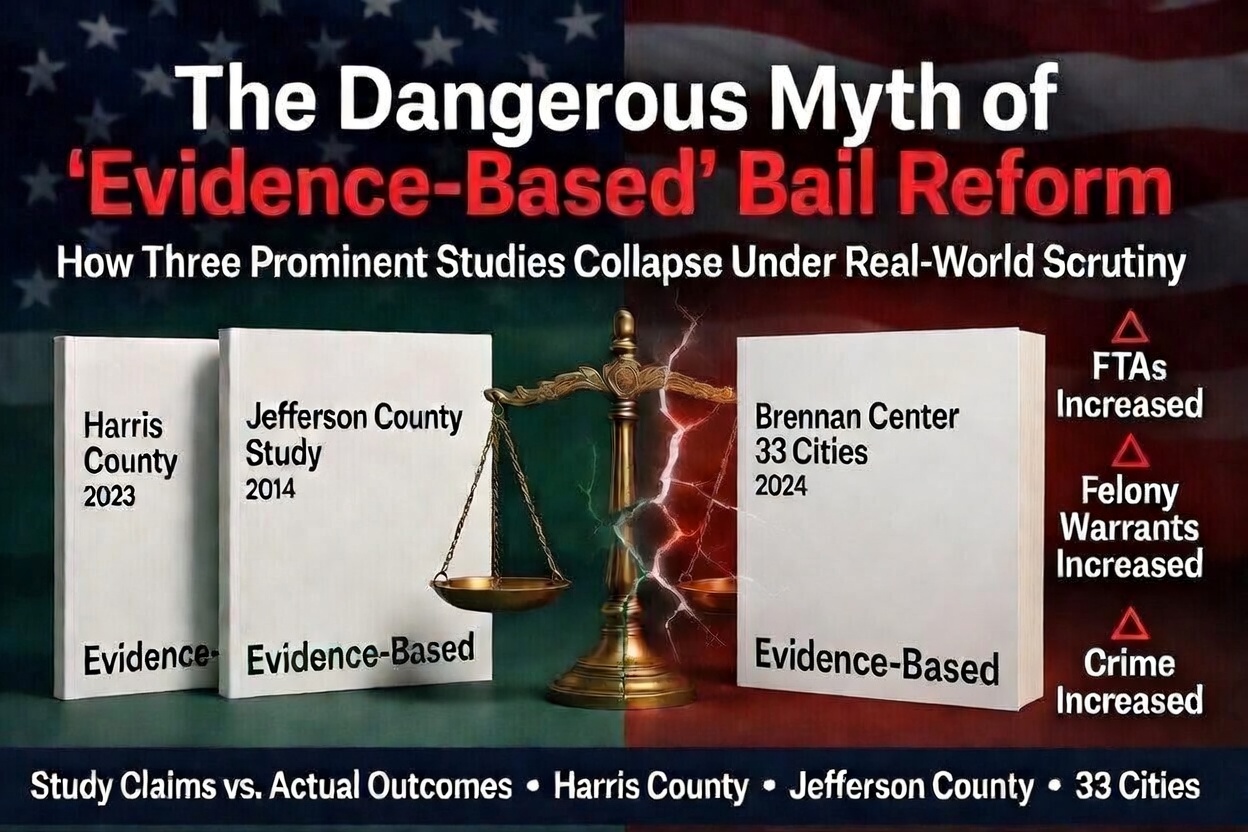 For years, bail reform advocates have conducted many high-profile studies and reported them as ironclad proof that eliminating or dramatically weakening surety bail is both safe and effective. Three of these reports in particular: the 2023 ideas42 Harris County Nonappearance Study, the 2014 Michael R. Jones Jefferson County (Colorado) Bail Impact Study, and the 2024 Brennan Center for Justice report on 33 cities, have consistently been used by bail reform advocates as proof that bail reform works and to drive policy. All these studies have been repeatedly cited as being “data-driven,” “rigorous,” and “evidence-based.”
Yet a closer examination reveals a troubling pattern: each study suffers from serious methodological deficiencies that make its conclusions unreliable. More importantly, the actual results in the very jurisdictions these studies examined have repeatedly contradicted their overly optimistic and increasingly questionable claims. When real data from independent sources, local officials, and long-term outcomes are considered, the narrative falls apart. And what is being sold as “evidenced based” is found to be nothing but pure ideology and propaganda. Below is an examination of the three studies mentioned earlier.
Study #1
ideas42 Harris County Nonappearance Study (2023)
This report, commissioned as part of the ongoing O’Donnell consent decree litigation, claimed that nonappearance is driven almost entirely by “structural barriers” such as poverty, lack of transportation, and fear of arrest, not by any lack of consequences. It recommended reducing court appearances, reminders, and any “scarcity-focused” interventions while downplaying financial accountability. Like many of these bail reform studies do, the author identifies serious flaws in the data being used in the research.
Critical flaws:
- The researchers explicitly admitted they could not reliably analyze actual failure-to-appear (FTA) rates because the court data was too inconsistent and “not reliable enough.” They noted wide variations across courtrooms, inconsistent coding of “not present” versus “waived,” lack of audits, and heavy COVID-era complications.
- The study relied instead on small qualitative samples: only 43 court-user interviews and 60 survey responses, plus 3,893 bail-revocation hearing records, all self-reported and unverified.
- Quantitative analysis was limited to 2021 data (peak pandemic disruption) with no credible pre- versus post-reform comparison.
Real-world contradiction:
Independent data compiled by the website, harriscountycourtwatch.com, using the same official court records, shows misdemeanor FTA rates frequently exceeding 80% in many courtrooms, with some periods far higher. Warrants have exploded, and the revolving-door effect is unmistakable. Former District Attorney Kim Ogg’s office documented increased re-offending by defendants released on personal recognizance (PR) bonds. The jurisdiction living under the policy has seen precisely the opposite of what ideas42 implied.
Study #2
Michael R. Jones Jefferson County (CO) Bail Impact Study (2014)
This short pilot study claimed that replacing cash and surety bonds with unsecured personal bonds produced similar or better court appearance and public-safety outcomes at lower cost.
Critical flaws:
- The pilot lasted only 14 weeks, an absurdly short window for measuring long-term system effects.
- It compared selective judge behavior rather than using a true randomized or controlled long-term design.
- The study ignored downstream consequences such as warrant accumulation and pretrial population growth.
Real-world contradiction:
In December 2016, Jefferson County’s District Attorney, Sheriff, and County Supervisor sent an official letter to the Maryland Supreme Court explicitly refuting the Jones study. After full implementation of the unsecured-bond model, they reported:
- Average daily pretrial population increased 29%
- Pretrial length of stay increased 29%
- Outstanding misdemeanor warrants increased 34%
- Outstanding felony warrants increased 42%
- The percentage of the pretrial population in jail rose from 35% to 42%
- The number of people staying in jail more than one day increased 141%
Jefferson County ultimately reinstated commercial bail because the “evidence-based” experiment failed on every metric the study had promised to improve. The dangerous result of this limited and flawed study is that it is being sold to legislators as evidence to drive bail reform policies in other states across the country…most recently, Washington State.
Study #3
Brennan Center for Justice – “Bail Reform and Public Safety: Evidence from 33 Cities” (2024)
This widely circulated report examined crime data from 33 cities between 2015 and 2021 and concluded there was “no statistically significant relationship” between bail reform and increases in crime.
Critical flaws:
- Extremely short post-reform observation windows for most cities (many reforms only began 2019–2021 and overlapped with the national COVID-era crime spike).
- Heavy data aggregation and cleaning that masked local spikes in violent crime and FTA/warrant backlogs.
- Failure to adequately isolate confounding factors such as reduced policing, prosecution, and the broader “defund” movement.
Real-world contradiction:
Several cities featured in the Brennan sample, including Harris County, New York City, Philadelphia, and Chicago, experienced documented rises in violent crime and/or massive increases in FTA rates and warrants after their reforms. In Harris County, independent Court Watch data and former DA Kim Ogg’s reports directly contradict the Brennan Center’s aggregate findings.
The Pattern Is Clear — And Concerning
All three studies are being used as support and proof that soft on crime bail reform policies are safe and effective. wave the banner of “evidence-based” and “data-driven” research while sharing the same fatal weaknesses:
- Selective or incomplete data sets
- Over-reliance on qualitative self-reports instead of hard metrics like FTA rates and warrants
- Short time frames that avoid long-term system effects
- Convenient omission of the very outcomes (repeat offending, warrant explosions, crime increases) that matter most to public safety
Meanwhile, the jurisdictions that implemented the policies these studies promote and defend have spoken with their results: higher FTA rates, more warrants, longer pretrial stays, increased re-offending, and, in multiple cases, reversals or major course corrections.
When advocacy documents dressed up as neutral research are used to drive policy, while the lived experience of the very places studied tells a different story, policymakers and the public are being misled. True evidence-based reform must start with complete, transparent data on court appearance, public safety, and system-wide costs, not cherry-picked metrics that support a predetermined conclusion.
Until that standard is met, claims that cash bail can be safely eliminated should be treated with the skepticism they deserve. The data from the front lines, not the academic papers, tells the real story