
Risk Assessments Are Not OK for Oklahoma
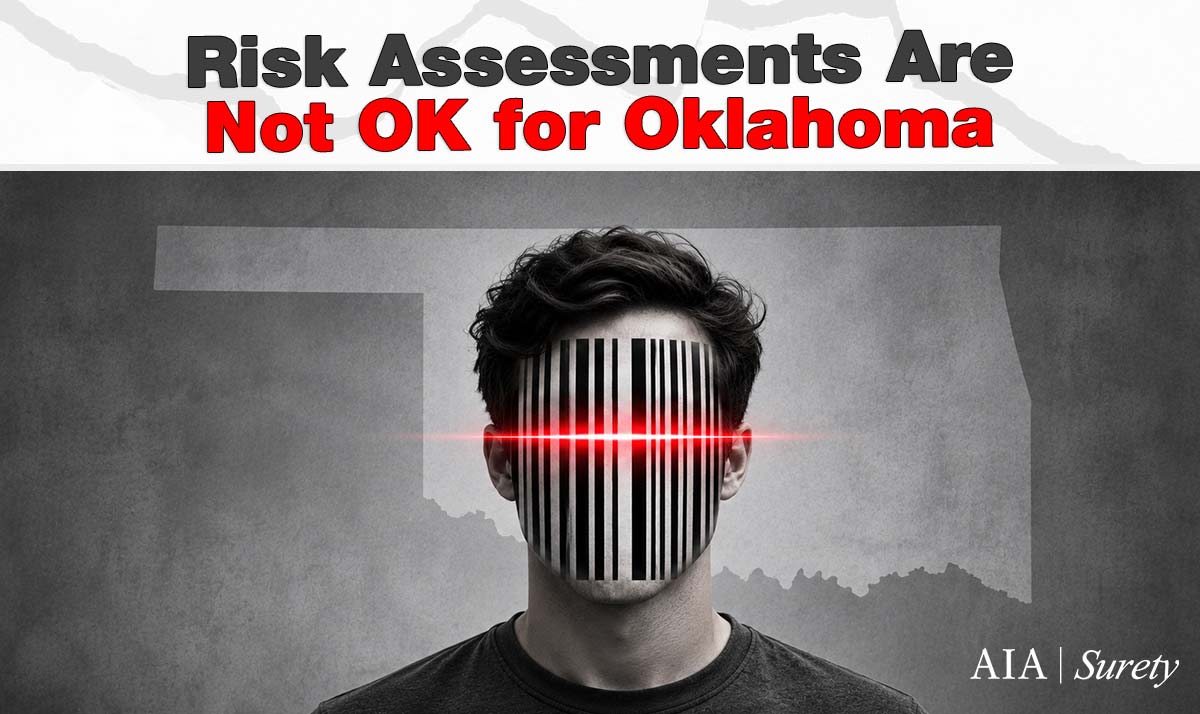 There has been much discussion in Oklahoma around newly proposed legislation to expand the use of pretrial risk assessment tools. These risk assessment tools are sold as a way to guide decisions about who is released before trial. Supporters of risk assessments market them as objective, evidence-based ways to protect public safety while reducing unnecessary detention. But in practice, these tools have fallen way short of those claims. In fact, those that are opposed to the use of these so-called “black box predictors” of human behavior have been very vocal about risk assessment tool failures. And this is not a left or right issue. Opposition comes from all sides of the political spectrum. They include major progressive and civil rights organizations, leading data scientists from some of the top institutions of higher learning from around the world, pretrial service organizations, law enforcement and many more. They have all rejected these risk assessments as racially biased and ineffective. Recently, a major randomized study connected to Harvard has found that one of the leading risk assessment tools developed by Arnold Ventures delivers essentially no meaningful predictive improvement. That finding is especially important since the goal of the risk assessment tool is to predict future behavior.
Progressive and Civil Rights Groups Reject Risk Assessments as Racially Biased
Far from being a consensus reform, pretrial risk assessments have drawn sharp criticism from many organizations that typically support reducing incarceration. In 2018, more than 100 civil rights, digital justice, and community groups, including the ACLU, the NAACP Legal Defense and Educational Fund, and The Leadership Conference on Civil and Human Rights, issued a shared statement opposing the use of these algorithmic tools as a substitute for ending money bail.
The groups argued that the tools rely on historical criminal justice data shaped by racially disparate policing and enforcement. Because arrest records, prior convictions, and failure-to-appear histories are not race-neutral, the algorithms can encode and amplify existing disparities under the appearance of scientific objectivity. Vanita Gupta (then president of The Leadership Conference) stated that “biased policing practices in communities of color result in racial disparities in the data risk assessment tools rely on, making Black and Brown people look riskier than White people.” The statement warned that the tools “can worsen racial disparities and allow further incarceration” and urged jurisdictions to avoid embedding them in pretrial decision-making.
The Pretrial Justice Institute, long associated with bail reform efforts, later reversed its earlier support. In 2020, it concluded that pretrial risk assessment tools “perpetuate structural racism and institutional inequities” and should not be used to make detention decisions or impose restrictions on pretrial liberty. Other organizations, including The Bail Project, have taken similar positions: the tools oversimplify complex human behavior, produce racially skewed recommendations through false positives concentrated on people of color, and undermine individualized due process.
It is important to point out that these are not conservative critiques from tough-on-crime groups.
The Harvard Study: Essentially Zero Predictive Benefit
Even setting aside fairness concerns, the tools fail a more basic test: do they actually help predict and improve outcomes?
A major randomized controlled trial organized by Harvard Law School’s Access to Justice Lab examined the Public Safety Assessment (PSA), the tool developed with support from Arnold Ventures and widely promoted for pretrial use. The study, which included sites in Dane County, Wisconsin; Polk County, Iowa; and Utah, compared cases in which the PSA was available to judges with cases in which it was not.
Researchers found no statistically significant improvements on key measures: failure to appear, new criminal activity, or reductions in pretrial detention. As Lab director Jim Greiner summarized, “The PSA is not making anything worse, but it’s not making anything better.” In other words, the expensive process of generating and presenting risk scores produced no measurable public safety or efficiency gains.
The question that surfaces now is why Oklahoma is even considering the implementation of a failed solution. Especially when simple logic tells us that if a tool does not meaningfully improve decisions over existing judicial practice, the justification for adopting it should make no sense.
Implications for Oklahoma
Oklahoma is in the process of considering a major overhaul of its criminal justice system. An overhaul that includes at its core the use of Arnold Ventures’ failed risk assessment. How is this possible when there is so much reliable opposition and research?
The combination of progressive opposition on racial-bias grounds and the Harvard findings of no practical predictive benefit should make the rejection of these tools a no-brainer. If the tools encode historical disparities from policing and charging patterns, expanding their use in Oklahoma only means that they will be expanding the risks of formalizing those disparities in Oklahoma’s courts. If risk assessments have been proven to not improve failure-to-appear or new-arrest rates in controlled settings, then why should anyone believe the promised public-safety gains?
Oklahoma can address public safety and pretrial fairness without relying on failed tools that rigorous testing has shown add little predictive value. Individualized hearings focused on specific charges and evidence, combined with targeted interventions for high-risk cases and stronger court-appearance supports, offer alternatives that do not depend on the contested premise that historical data can reliably forecast future behavior for any given defendant. Oklahomans should speak up and let their legislators know that they do not support the use of risk assessments in their state. Especially not ones pushed by progressive billionaire groups that have already been proven to be ineffective.
Sources
- Harvard Law School Access to Justice Lab, Randomized Control Trial Evaluation of the Implementation of the PSA-DMF System in Dane County, WI (2020).
- Experimental Evaluation of Algorithm-Assisted Human Decision-Making: Application to Pretrial Public Safety Assessment, Journal of the Royal Statistical Society (2023).
- The Leadership Conference on Civil and Human Rights, More Than 100 Civil Rights, Digital Justice, and Community-Based Organizations Raise Concerns About Pretrial Risk Assessment (2018).
- Pretrial Justice Institute, Updated Position on Pretrial Risk Assessment Tools (2020).
- Oklahoma State Legislature, Senate Bill 1618: Public Protection Act (2026).
- The Appeal, Risk Assessment: Explained (2019).