
The Three Most Significant Supreme Court Cases for Bail Bonds
Have you ever wondered what role the courts, and the Supreme Court in particular, have played in ensuring the availability and existence of financially secured release in our criminal justice system?
Over the past 120 years, bail has been debated at the local, state and national levels. Through those debates, legal challenges and legislative experiments, three key Supreme Court cases stand out. These cases have not only supported the existence of financially secured release, they have also reinforced its constitutionality and established its role in a balanced criminal justice system.
Those three cases are:
- Taylor v. Taintor (1872)
- Stack v. Boyle (1951)
- United States v. Salerno (1987)
From establishing the right to apprehend and surrender a defendant, to requiring bail to be set at a reasonable level to ensure appearance, to emphasizing the importance of accountability in pretrial release, these three cases helped create the modern legal framework for how bail operates today.
Over the next three weeks, we will examine each of these Supreme Court cases and explain why they mattered when they were decided and why they still matter in defining surety bail today.
For anyone who works in the criminal justice system, understanding these cases is essential to understanding why the bail profession remains important to ensuring the wheels of justice continue to turn and that both defendants and victims of crime get their day in court.
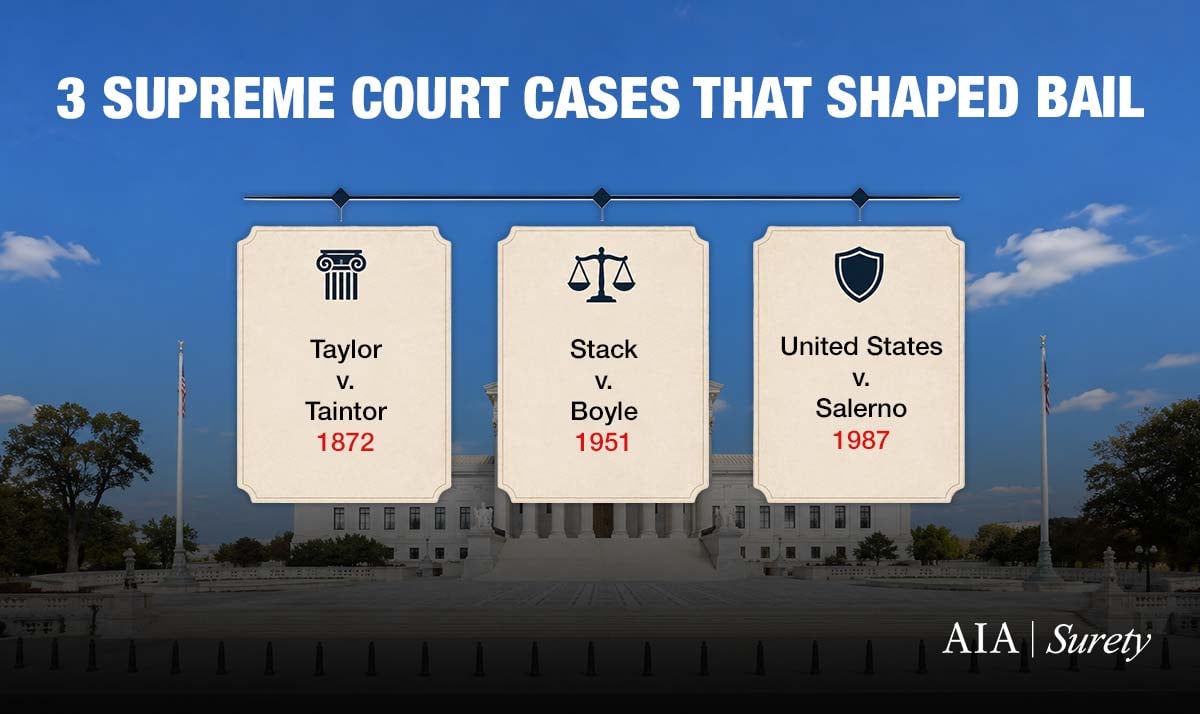
The Three Most Significant Bail Supreme Court Cases
Intro: The Three Most Significant Bail Supreme Court Cases
Landmark Supreme Court Decisions That Shaped Surety Bail
This series examines three major Supreme Court cases that helped define the legal foundation of bail, surety bonds and financially secured release in America.
Part 1: Taylor v. Taintor
In 1872, the U.S. Supreme Court issued a decision that would become the legal cornerstone of the commercial surety bail system in the United States. The case, Taylor v. Taintor, 83 U.S. 366, established fundamental legal principles that continue to support the use of surety bonds more than 150 years later.
Part 2: Stack v. Boyle
In 1951, the U.S. Supreme Court issued a landmark decision in Stack v. Boyle that continues to shape bail law and policy more than seven decades later.
Part 3: United States v. Salerno
In 1987, the U.S. Supreme Court upheld the Bail Reform Act of 1984 in United States v. Salerno, one of the Court’s most important decisions affecting modern bail law.